Every modern car has a dashboard filled with symbols, gauges, and warning lights. Many drivers see these lights every day, but not everyone knows what they actually mean. Some dashboard warning lights are simple reminders, while others can indicate a serious mechanical or safety problem.
Understanding dashboard warning lights is an important part of responsible car ownership. A warning light can help you identify a small issue before it becomes an expensive repair. In some situations, it can also protect you from a breakdown or accident.
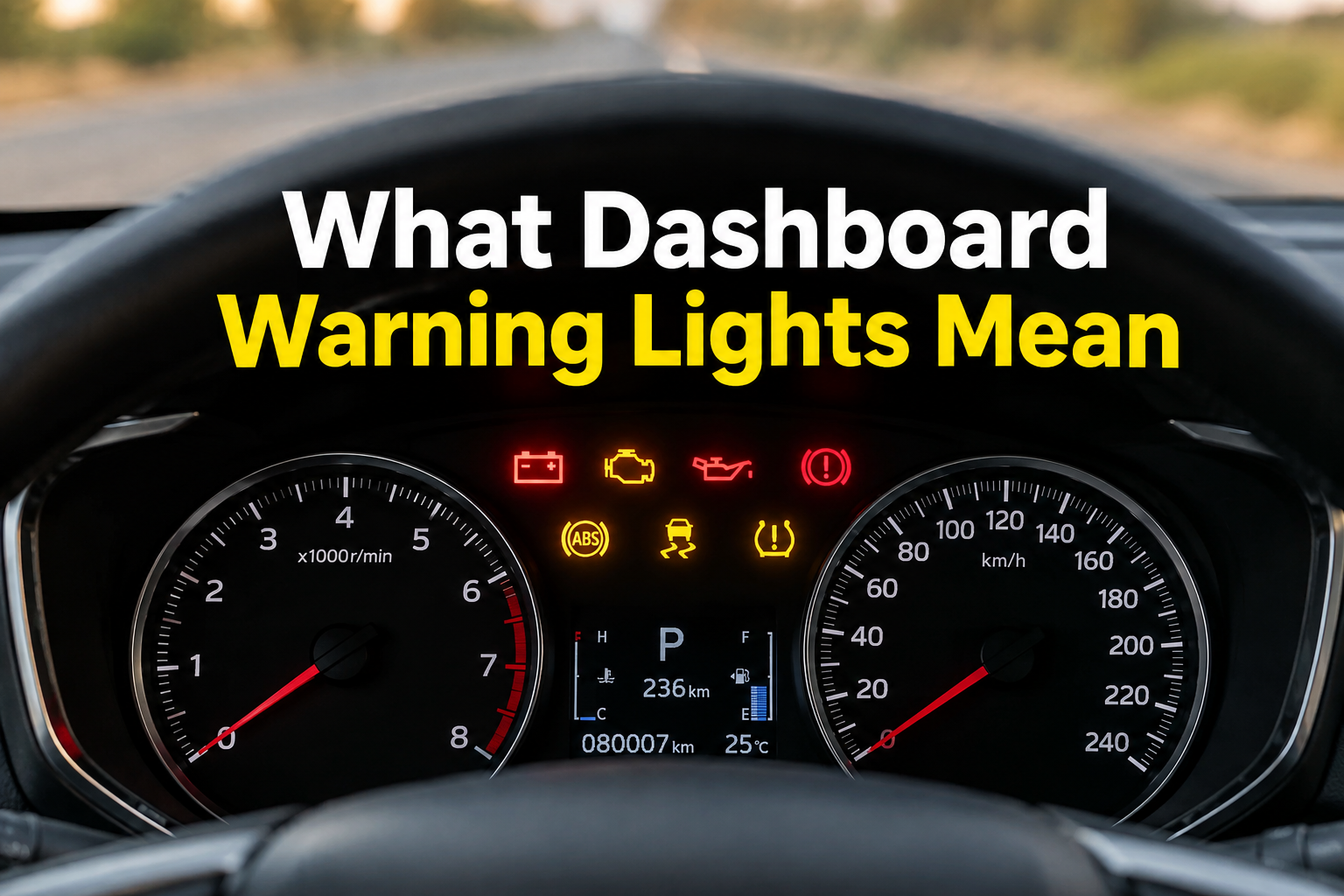
Most dashboard lights use different colors to show the level of urgency. Red lights usually indicate a serious problem that requires immediate attention. Yellow or orange lights normally mean that something needs to be checked soon. Green and blue lights are usually informational and simply tell you that a feature is active.
This guide explains the most common dashboard warning lights, what they mean, what may cause them, and what you should do when they appear.
Why Dashboard Warning Lights Matter
Your car contains many sensors that constantly monitor important systems. These sensors check the engine, transmission, brakes, battery, tires, airbags, emissions system, and other components.
When the vehicle computer detects something unusual, it may illuminate a warning light on the dashboard.
The warning light does not always tell you exactly which part has failed. Instead, it tells you which system needs attention.
Ignoring a dashboard warning light can sometimes turn a minor problem into a major repair. For example, ignoring a low oil pressure warning may lead to serious engine damage. Ignoring a brake warning light may create a safety risk.
Learning what the symbols mean can therefore help you make better decisions about maintenance and repairs.
Dashboard Warning Light Colors Explained
Before looking at individual warning lights, it helps to understand the basic color system.
Red Warning Lights
Red warning lights normally indicate an urgent problem.
A red light may mean that you should stop the vehicle as soon as it is safe to do so.
Examples include:
Engine oil pressure warning
Brake system warning
Engine temperature warning
Battery charging warning
Seat belt warning
Some red symbols can indicate a situation where continuing to drive may damage the vehicle or create a safety risk.
Yellow or Orange Warning Lights
Yellow and orange lights usually indicate a problem that should be investigated.
The vehicle may still be safe to drive for a short distance, depending on the warning.
Examples include:
Check engine light
ABS warning light
Tire pressure warning
Traction control warning
A yellow light should not normally be ignored for a long period.
Green and Blue Dashboard Lights
Green and blue lights are usually informational.
They often indicate that a particular feature is currently operating.
Examples include:
Headlights
Cruise control
Turn signals
High beams
Fog lights
These lights usually do not indicate a mechanical problem.
Check Engine Light
The check engine light is one of the most common dashboard warning lights.
It normally appears as a small engine shaped symbol. Some vehicles may also display the words Check Engine.
This warning is connected to the engine management and emissions system.
Many different problems can cause the check engine light to appear.
Common causes include:
Loose fuel cap
Faulty oxygen sensor
Worn spark plugs
Ignition coil problems
Fuel injection problems
Catalytic converter issues
Air intake problems
Emissions system faults
A steady check engine light usually means that the vehicle should be inspected soon.
A flashing check engine light is more serious. It can indicate severe engine misfiring that may damage the catalytic converter.
If the light is flashing, avoid heavy acceleration and arrange an inspection as soon as possible.
Engine Oil Pressure Warning Light
The oil pressure warning light usually looks like an old fashioned oil can.
This is one of the most important dashboard warning lights.
It normally means that the engine does not have enough oil pressure to properly lubricate internal components.
Possible causes include:
Low engine oil level
Oil pump failure
Oil leak
Blocked oil passages
Faulty oil pressure sensor
Driving with low oil pressure can cause severe engine damage within a short period.
If the oil pressure warning appears while driving, pull over safely and switch off the engine.
Check the engine oil level after allowing the engine to cool.
If the oil level is extremely low, adding the correct engine oil may help. However, if the warning remains on, the vehicle should be inspected before further driving.
Engine Temperature Warning Light
The engine temperature warning light normally shows a thermometer surrounded by waves.
It means that the engine temperature has become too high.
An overheating engine can suffer serious damage if the problem is ignored.
Common causes of overheating include:
Low coolant level
Coolant leaks
Faulty thermostat
Radiator problems
Cooling fan failure
Water pump failure
Blocked coolant passages
If the temperature warning appears, stop the vehicle in a safe location.
Turn the engine off and allow it to cool.
Never remove the radiator cap while the engine is hot because pressurized coolant may cause serious burns.
Once the engine has cooled, the coolant level can be checked.
Repeated overheating should always be investigated by a qualified mechanic.
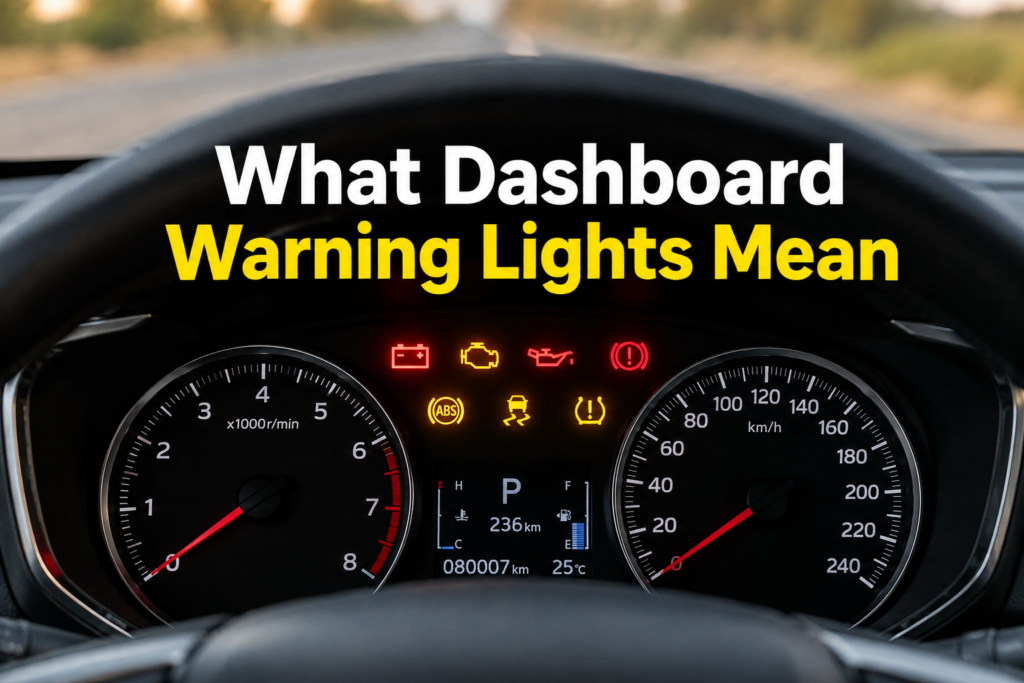
Battery Charging Warning Light
The battery warning symbol normally looks like a battery with positive and negative signs.
Many drivers assume that this light always means the battery itself is bad. However, it actually indicates a problem with the charging system.
Possible causes include:
Weak alternator
Broken drive belt
Loose battery connection
Damaged wiring
Faulty charging system component
If the alternator stops charging the battery, the vehicle may continue running for a short time using stored battery power.
Eventually, the battery will lose its charge and the engine may stop.
If the battery warning light appears while driving, unnecessary electrical equipment should be switched off.
The charging system should then be checked as soon as possible.
Brake Warning Light
The brake warning light is usually red.
It may appear as the word Brake or as an exclamation mark inside a circle.
Sometimes the light appears simply because the parking brake is engaged.
If the parking brake is completely released and the warning remains on, there may be another problem.
Possible causes include:
Low brake fluid
Hydraulic brake system problem
Brake fluid leak
Worn brake components
Brake system sensor issue
A brake warning light should always be taken seriously.
If the brake pedal feels soft, unusually low, or difficult to operate, avoid driving the vehicle and arrange professional assistance.
ABS Warning Light
ABS stands for Anti Lock Braking System.
The ABS warning light normally shows the letters ABS inside a circle.
When the light stays on, the anti lock braking system may not be functioning correctly.
The normal braking system may still work, but the ABS feature may be disabled.
Possible causes include:
Faulty wheel speed sensor
Damaged sensor wiring
ABS control module problem
Low system voltage
Damaged ABS tone ring
ABS helps prevent the wheels from locking during heavy braking.
Because it is an important safety system, the vehicle should be inspected if the warning remains on.
Tire Pressure Warning Light
The tire pressure warning light normally looks like a tire with an exclamation mark inside it.
It is part of the Tire Pressure Monitoring System, commonly called TPMS.
The warning usually means that one or more tires have low air pressure.
Possible reasons include:
Natural air loss
Temperature changes
Slow puncture
Damaged tire
Faulty TPMS sensor
Low tire pressure can reduce fuel efficiency and affect vehicle handling.
It can also increase tire wear.
Check the pressure of all tires using an accurate tire pressure gauge.
Inflate each tire according to the recommended pressure listed in the owner’s manual or on the vehicle tire information label.
Airbag Warning Light
The airbag warning light usually shows a seated person with a circle in front of them.
The circle represents the airbag.
If this light stays on, there may be a problem with the airbag system or seat belt pretensioners.
Possible causes include:
Faulty airbag sensor
Damaged wiring
Seat belt sensor problem
Airbag control module fault
Previous accident related damage
An airbag system problem does not normally affect how the car drives.
However, the airbags may not deploy correctly during an accident.
For this reason, the warning should be inspected by a professional.
Traction Control Warning Light
The traction control symbol normally looks like a car with curved lines underneath it.
These lines represent tire slip.
If the light flashes while driving, it usually means that the traction control system is actively helping the vehicle maintain grip.
This can happen on wet, icy, sandy, or slippery roads.
If the light stays on continuously, there may be a fault with the traction control system.
Common causes include:
Wheel speed sensor problems
ABS system faults
Traction control sensor failure
Electronic stability system problems
The vehicle may still drive normally, but some electronic safety assistance may not be available.
Electronic Stability Control Light
Electronic Stability Control helps drivers maintain control during sudden steering movements or loss of traction.
The warning symbol often looks similar to the traction control symbol.
When the light flashes, the system is usually operating normally and correcting wheel slip.
If it remains illuminated, the system may have a fault.
Electronic Stability Control can be especially useful during emergency maneuvers and on slippery roads.
A permanent warning light should therefore be investigated.
Power Steering Warning Light
Some modern vehicles use electric power steering rather than hydraulic steering.
If the power steering warning light appears, steering assistance may be reduced or unavailable.
The steering wheel may become unusually heavy.
Possible causes include:
Electric steering motor failure
Low electrical voltage
Steering sensor problem
Control module fault
In vehicles with hydraulic power steering, low fluid or a leaking system can also cause steering problems.
If steering suddenly becomes difficult, slow down carefully and stop in a safe location.
Transmission Temperature Warning Light
Some vehicles have a transmission temperature warning.
The symbol may look like a thermometer or gear symbol.
It means that the transmission fluid temperature has become too high.
Possible causes include:
Heavy towing
Driving in extreme heat
Low transmission fluid
Transmission cooling problem
Internal transmission fault
Excessive transmission heat can damage internal components.
If the warning appears, reduce the load on the vehicle and stop safely if necessary.
Allowing the transmission to cool may help temporarily, but repeated overheating requires inspection.
Low Fuel Warning Light
The low fuel warning symbol normally looks like a fuel pump.
It simply means the fuel level is becoming low.
Although it is not normally an emergency, repeatedly driving with very little fuel is not a good habit.
Running extremely low on fuel can leave you stranded and may place additional stress on the fuel pump in some vehicles.
Refuel as soon as reasonably possible.
Seat Belt Warning Light
The seat belt warning normally shows a seated person wearing a belt.
It often appears together with an audible warning.
The light indicates that the driver or a passenger has not fastened their seat belt.
Seat belts are one of the most important vehicle safety systems.
Always make sure every occupant is properly restrained before driving.
Door Open Warning Light
The door open warning shows that one of the vehicle’s doors is not fully closed.
Some vehicles also monitor the hood and trunk.
Before driving, check that all doors are completely closed.
An improperly closed door can become a safety risk while the vehicle is moving.
Washer Fluid Warning Light
The washer fluid warning often looks like a windshield with water spraying across it.
It means the windshield washer fluid level is low.
This is usually a minor maintenance issue.
However, windshield washer fluid is important for maintaining visibility, especially during dusty, muddy, or rainy conditions.
Refill the reservoir with suitable windshield washer fluid.
Diesel Glow Plug Warning Light
Diesel vehicles may have a glow plug warning symbol that looks like a small coil.
Glow plugs help warm the combustion chamber before starting a diesel engine.
When the ignition is switched on, the light may appear briefly.
Normally, you should wait until it switches off before starting the engine.
If the glow plug light stays on or flashes while driving, there may be a problem with the glow plug system or engine management system.
Diesel Particulate Filter Warning Light
Many modern diesel vehicles use a Diesel Particulate Filter, commonly called a DPF.
The filter traps soot from the exhaust gases.
A DPF warning light may appear when the filter becomes too full.
Sometimes driving the vehicle at a steady highway speed allows the regeneration process to clean the filter.
However, if the warning continues, professional servicing may be required.
Ignoring the warning for too long can cause expensive exhaust system problems.
Coolant Level Warning Light
Some vehicles have a separate coolant level warning.
This is different from the engine temperature warning.
It means the coolant level in the reservoir may be too low.
Possible causes include:
Small coolant leak
Radiator leak
Damaged hose
Water pump leak
Coolant reservoir problem
Check the coolant only after the engine has cooled.
Repeated coolant loss should be investigated because the cooling system should normally remain sealed.
Service Reminder Light
A service reminder is not always a warning of a mechanical failure.
It usually means that scheduled maintenance is due.
Typical maintenance may include:
Engine oil replacement
Oil filter replacement
Air filter inspection
Brake inspection
Fluid checks
General vehicle inspection
Following the recommended maintenance schedule can improve reliability and help prevent expensive repairs.
Can You Drive With a Dashboard Warning Light On?
The answer depends on the warning light.
Some lights are simply reminders or information indicators.
Others require immediate attention.
A green light usually means that a feature is active.
A yellow light normally means that the vehicle should be checked soon.
A red warning light may mean that you should stop driving as soon as it is safe.
The owner’s manual is one of the best sources for understanding the exact symbols used in your specific vehicle.
Different manufacturers sometimes use slightly different warning symbols.
What to Do When a Warning Light Appears
When a dashboard warning light appears, avoid panicking.
First, identify the symbol and its color.
Then consider how the vehicle is behaving.
If the engine is overheating, the oil pressure warning is on, the brakes feel unusual, or the vehicle is losing power, stop in a safe location.
If the warning is yellow and the vehicle appears to be operating normally, arrange an inspection soon.
An automotive diagnostic scanner can also help identify problems connected to the engine computer.
However, diagnostic trouble codes should be interpreted carefully. A code often points to the system where the problem was detected rather than automatically identifying the exact failed part.
Why Warning Lights Sometimes Come On and Go Off
A dashboard warning light may occasionally appear and then disappear.
This can happen because the problem is intermittent.
Examples include:
Loose electrical connection
Temporary sensor reading
Low battery voltage
Moisture around electrical components
Changing tire pressure
Temporary engine misfire
Even if the light switches off, repeated warnings should not be ignored.
The vehicle computer may store a diagnostic trouble code that can help identify the problem.
Why Reading the Owner’s Manual Is Important
Dashboard symbols can vary between manufacturers.
For example, one manufacturer may use a slightly different symbol for the electronic stability system than another.
Your owner’s manual explains the specific dashboard lights installed in your vehicle.
It also tells you what actions the manufacturer recommends when a warning appears.
Keeping the manual inside the vehicle can be useful when an unfamiliar symbol suddenly appears.
How Regular Maintenance Prevents Warning Lights
Many warning lights appear because routine maintenance has been delayed.
Regular maintenance can reduce the chances of unexpected dashboard warnings.
Important maintenance includes:
Checking engine oil
Maintaining coolant levels
Checking tire pressure
Replacing worn spark plugs
Servicing brakes
Testing the battery
Replacing filters
Inspecting belts and hoses
Following scheduled servicing
A well maintained vehicle is less likely to develop sudden mechanical problems.
Frequently Asked Questions
What is the most serious dashboard warning light?
Several dashboard warning lights can indicate serious problems. Oil pressure, brake system, engine temperature, and charging system warnings should be treated carefully.
Can I continue driving with the check engine light on?
If the check engine light is steady and the vehicle is running normally, you may be able to drive carefully for a short distance. However, the problem should be diagnosed soon. A flashing check engine light requires more urgent attention.
Why are dashboard warning lights different colors?
Colors help drivers quickly understand how serious the situation may be. Red normally means urgent attention, yellow means caution, and green or blue usually provides information.
Why does my dashboard show multiple warning lights at once?
Multiple warning lights can appear because several systems are connected electronically. Low battery voltage, sensor problems, or communication faults can sometimes trigger several warnings together.
Can a weak battery cause dashboard warning lights?
Yes. Low system voltage can sometimes cause different warning lights to appear because many vehicle control modules depend on stable electrical power.
Should I reset a dashboard warning light myself?
Resetting a light without fixing the cause may only hide the problem temporarily. The underlying issue should be diagnosed first.
Final Thoughts
Dashboard warning lights are one of the most useful communication systems inside a modern vehicle. They allow the car to tell you when a system is operating normally, when maintenance is required, or when a serious problem may be developing.
Learning what dashboard warning lights mean can help you react correctly and avoid unnecessary damage.
Red warning lights generally require immediate attention. Yellow or orange lights usually indicate that a system should be checked soon. Green and blue lights are commonly informational.
The most important rule is not to ignore a warning simply because the car still seems to be driving normally. Mechanical and electrical problems often begin before noticeable symptoms appear.
Regular maintenance, checking your owner’s manual, and responding promptly to dashboard warnings can help keep your vehicle safe, reliable, and economical for many years.