Hot weather can be surprisingly hard on a car battery. Most drivers associate battery problems with cold winter mornings, but high temperatures can also shorten battery life and increase the chances of unexpected starting problems.
Your car battery works quietly every time you drive. It provides the electrical power needed to start the engine and supports many electrical systems when necessary. When temperatures rise, the chemical activity inside the battery increases. While this may sound helpful, excessive heat can speed up internal deterioration and increase fluid loss.
Learning how to take care of your car battery in hot weather can help you avoid unnecessary trouble, improve reliability, and potentially extend the useful life of the battery. Fortunately, good battery care does not require advanced mechanical knowledge. A few simple habits can make a noticeable difference.
This guide explains how heat affects a car battery, what warning signs you should watch for, and what you can do to protect your battery during hot weather.
Why Hot Weather Is Hard on a Car Battery
A car battery depends on chemical reactions to store and release electrical energy. Temperature has an important effect on these reactions.
When the weather becomes extremely hot, chemical activity inside a conventional lead acid battery increases. At the same time, prolonged exposure to heat can accelerate corrosion of internal components. High temperatures can also encourage water in the electrolyte to evaporate more quickly in serviceable batteries.
This means a battery may continue working normally during summer while slowly becoming weaker internally. The problem may not become obvious until later.
This is one reason battery maintenance during summer should not be ignored.
Modern vehicles also place significant electrical demands on batteries. Air conditioning controls, entertainment systems, navigation equipment, charging ports, security systems, lights, sensors, and computers all depend on a healthy electrical system.
A weak battery combined with high temperatures and frequent short journeys can eventually create starting problems.
Keep Your Car Away From Excessive Heat When Possible
One of the simplest ways to protect your car battery in summer is to reduce unnecessary heat exposure.
A car parked directly under strong sunlight can become extremely hot. The temperature under the hood may rise significantly, especially after the engine has already been running.
Whenever practical, park your vehicle in a garage, covered parking area, or shaded location.
Of course, finding shade is not always possible. You should never compromise safety or park illegally simply to protect the battery. However, when you have a choice between direct sunlight and covered parking, the cooler location can be beneficial for the entire vehicle.
Reducing heat exposure may also help protect interior materials, electronics, paint, and other components.
Inspect the Battery Regularly
A quick visual inspection can reveal battery problems before they become serious.
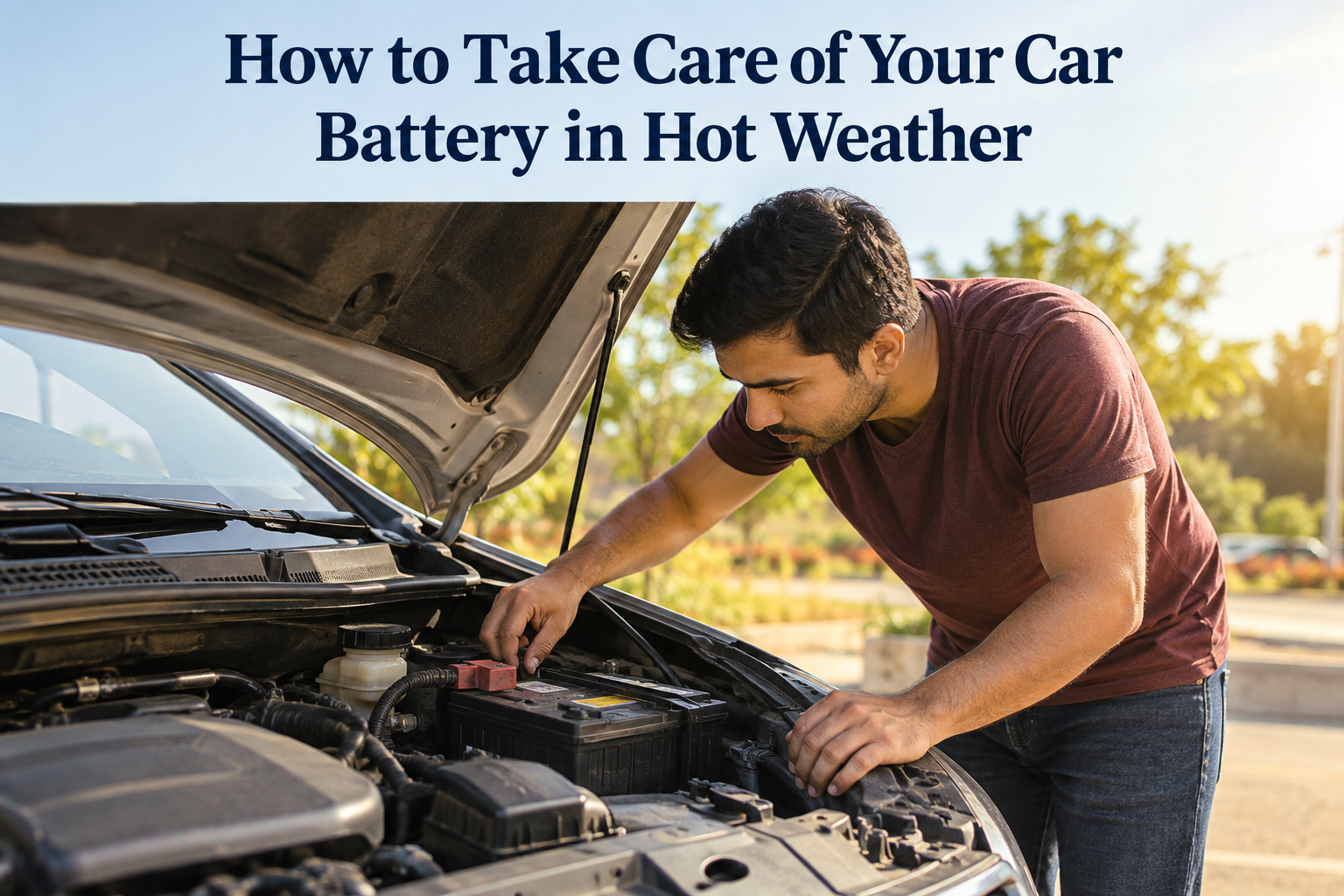
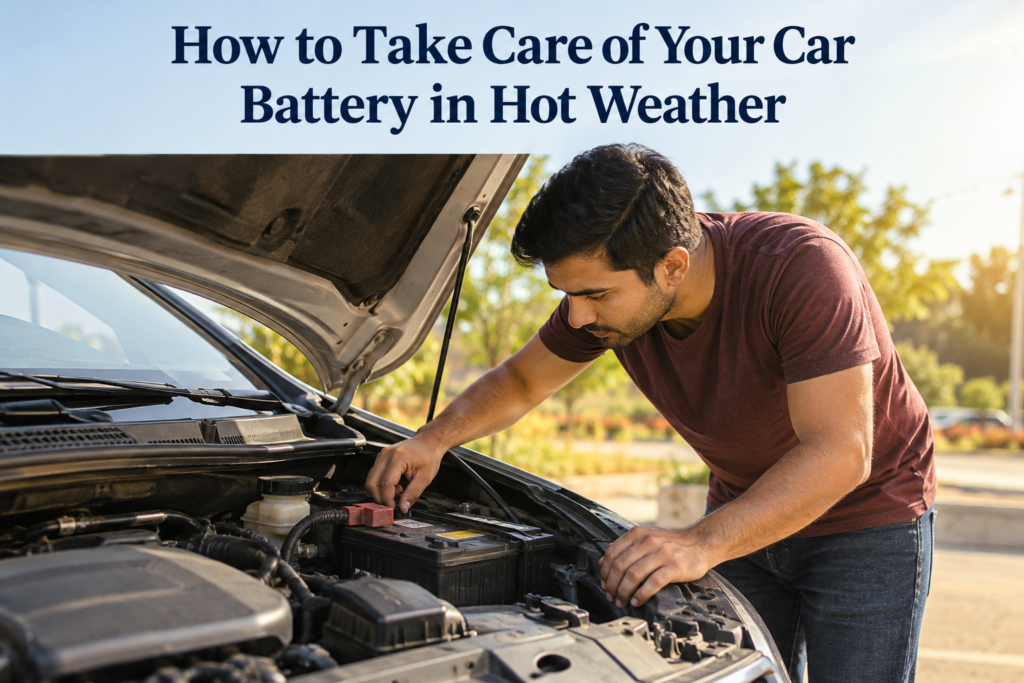
Open the hood when the engine is switched off and the vehicle is safely parked. Locate the battery and examine its general condition.
Look for corrosion around the terminals, loose connections, cracks, unusual swelling, leaking fluid, or obvious physical damage.
A swollen or badly damaged battery should not be ignored. Excessive heat or internal problems can sometimes cause the battery case to change shape.
Do not attempt to open or repair a sealed battery yourself. Battery electrolyte is corrosive, and batteries can produce flammable gases. If the battery appears damaged, have it inspected by a qualified technician.
Regular inspection is especially useful before a long summer road trip.
Check the Battery Terminals for Corrosion
Battery terminal corrosion can interfere with the flow of electricity between the battery and the vehicle.
You may notice a white, blue, or greenish substance around the battery terminals or cable connections. Even if the battery itself still has sufficient capacity, poor terminal connections can make starting difficult.
Check the terminals periodically.
If corrosion is present, it should be cleaned using an appropriate and safe battery cleaning method. Wear suitable eye and hand protection and follow the vehicle manufacturer’s instructions. If you are uncomfortable working around a battery, let a mechanic or battery technician handle the cleaning.
The connections should also be secure.
A loose battery terminal can create intermittent electrical problems and make a healthy battery appear faulty.
Keep the Battery Securely Mounted
A car battery should not move around inside the engine compartment.
Vehicles normally use a battery hold down system to keep the battery securely positioned. Over time, this hardware can become loose or damaged.
Excessive battery movement and vibration may contribute to internal damage and can place unnecessary stress on the terminals and cables.
During your visual inspection, check whether the battery appears firmly mounted.
Do not overtighten battery hardware because excessive force can damage the battery case. If the mounting system is missing or broken, have it repaired properly.
This is a small detail that is easy to overlook, but it forms an important part of good car battery maintenance.
Test Your Battery Before Peak Summer Heat
You do not have to wait until your car refuses to start before checking the battery.
Battery testing can provide useful information about its condition. Many automotive workshops and battery shops can perform a battery test relatively quickly.
Testing becomes particularly important if the battery is several years old or if you have noticed slower engine cranking.
A technician can check battery voltage and starting performance and may perform a load or conductance test depending on the equipment available.
The charging system can also be checked.
Remember that replacing a battery without investigating the charging system is not always the best solution. An alternator or electrical problem can sometimes produce symptoms similar to those of a weak battery.
Pay Attention to Slow Engine Cranking
One of the most common signs of a weakening battery is slow engine cranking.
When you turn the key or press the start button, the engine should normally crank with a strong and consistent sound.
If it suddenly sounds slower than usual, the battery may be losing its ability to provide enough starting current.
Do not ignore repeated slow starting.
The problem could be related to the battery, terminals, starter motor, charging system, or another electrical issue. Having the vehicle checked early may prevent you from becoming stranded later.
A car that starts today is not necessarily proof that the battery is in excellent condition.
Watch for Other Signs of a Weak Car Battery
Battery problems can appear in several ways.
Common warning signs may include difficulty starting the engine, repeated clicking when attempting to start, unusually dim lights during starting, electrical accessories behaving strangely, or a battery warning related message.
Some modern vehicles may display warnings when system voltage becomes too low.
However, these symptoms do not automatically prove that the battery itself is defective. Charging system faults and poor electrical connections can cause similar problems.
That is why proper testing is better than guessing.
Check Fluid Levels Only on Serviceable Batteries
Some traditional lead acid batteries allow the electrolyte level to be checked and maintained. Many modern batteries, however, are sealed or maintenance free and should not be opened.
If your battery is designed to be serviced, follow the manufacturer’s instructions carefully.
Hot weather can contribute to fluid loss, which makes electrolyte level particularly important in serviceable batteries.
If the level is low, the correct procedure and type of water specified by the battery manufacturer should be used. Distilled or demineralized water is commonly specified for serviceable lead acid batteries.
Never add acid unless a battery manufacturer or qualified professional specifically requires it as part of an approved procedure.
Most importantly, never attempt to remove caps from a battery that is designed to remain sealed.
Make Sure the Charging System Is Working Correctly
Your battery and alternator work together.
The battery supplies the energy required for starting, while the alternator provides electrical power when the engine is running and replenishes energy used from the battery.
If the alternator is not charging properly, even a relatively new battery can become discharged.
Overcharging can also be harmful because excessive charging voltage can increase heat and accelerate battery deterioration.
If you repeatedly experience battery problems, ask a qualified technician to test both the battery and charging system.
Finding the actual cause is usually more economical than repeatedly replacing batteries.
Avoid Leaving Electrical Accessories On
Leaving electrical equipment operating while the engine is off can drain the battery.
Headlights are an obvious example, but modern vehicles contain many other electrical devices.
Interior lights, entertainment systems, charging accessories, and other equipment may continue consuming electricity after the engine has stopped.
Many modern cars automatically switch certain systems off to protect the battery, but you should not depend completely on this feature.
Before leaving the vehicle, make sure unnecessary accessories are switched off.
This becomes particularly important when the battery is already aging or the vehicle is not driven frequently.
Avoid Too Many Very Short Trips
Short journeys can be convenient, but repeated extremely short trips may not always give the charging system enough driving time to replenish the energy used during starting.
Starting an engine requires a considerable burst of electrical power.
If the car is repeatedly started, driven only a short distance, switched off, and started again, the battery’s state of charge may gradually decline.
The exact charging behavior depends on the vehicle, battery condition, electrical load, temperature, and charging system design.
You do not need to drive unnecessarily just for the battery. However, if your driving pattern consists almost entirely of very short trips, battery condition deserves extra attention.
Take Care of a Car That Is Rarely Driven
A parked car still uses some electricity.
Security systems, keyless entry equipment, clocks, computers, and other electronic modules can create a small continuous electrical load.
Normally this is not a problem when the car is driven regularly. But if the vehicle remains parked for a long period, the battery can gradually discharge.
If you own a car that is rarely used, consider an appropriate battery maintainer designed for your battery type.
A quality smart maintainer can monitor battery condition and provide charging when required.
Always make sure the charger is compatible with your particular battery technology.
This is especially important with AGM, EFB, lithium based, and other specialized automotive batteries because charging requirements can differ.
Know the Age of Your Battery
Battery age is another important consideration.
There is no single lifespan that applies to every car battery. Battery life depends on climate, vehicle design, driving habits, battery construction, charging conditions, maintenance, and overall quality.
Hot climates can be particularly demanding.
Check the manufacturing or installation date if it is available. If your battery is getting older and you notice starting problems, testing it before the hottest part of the year is sensible.
Do not replace a perfectly functional battery simply because it has reached a certain age. Instead, combine age with actual testing and observed performance.
This approach helps avoid unnecessary replacement while reducing the risk of unexpected failure.
Be Careful When Jump Starting a Car
A discharged battery can sometimes be started using another suitable power source, but jump starting must be performed correctly.
Incorrect cable connections can damage electrical components, create sparks, or cause personal injury.
Modern vehicles can contain sensitive electronic systems, so always follow the procedure described in the owner’s manual.
Never attempt to jump start a battery that appears cracked, frozen, leaking, severely swollen, or physically damaged.
If you are uncertain about the correct procedure, roadside assistance is a safer option.
Consider Your Battery Type
Not every vehicle uses the same battery technology.
Traditional flooded lead acid batteries remain common, while many modern vehicles use AGM or EFB batteries. Vehicles equipped with automatic start stop technology may require a specific battery type.
Some vehicles also use different battery technologies depending on their electrical architecture.
When replacement eventually becomes necessary, choose a battery that meets the specifications required by the vehicle manufacturer.
Physical size is not the only consideration.
Battery capacity, starting performance, terminal configuration, technology, and vehicle charging strategy can all matter.
Installing an unsuitable battery may lead to poor performance or reduced battery life.
Some modern cars also require battery registration or electronic adaptation after replacement. Check the owner’s manual or ask a qualified technician about the requirements for your vehicle.
Do Not Ignore the Battery Warning Light
Many drivers assume the battery shaped warning light means the battery needs replacement.
That is not always correct.
When this warning appears while the engine is running, it can indicate a problem with the vehicle’s charging system.
The alternator, drive belt, wiring, connections, electronic charging controls, or another component could be involved.
If the charging system stops working while you are driving, the vehicle may continue operating temporarily using stored battery energy. Eventually, however, the available electrical power can run out.
A charging system warning should therefore be investigated promptly.
Prepare the Battery Before a Summer Road Trip
Long road trips often place additional demands on a vehicle.
Before traveling in very hot weather, include the battery in your basic vehicle inspection.
Check its physical condition, terminals, mounting, and age. If you have any doubts about its performance, have it tested.
It is also sensible to inspect other important vehicle systems such as tires, coolant, engine oil, lights, brakes, and air conditioning.
Preventive checks cannot guarantee that a component will never fail, but they can help identify obvious problems before you leave home.
Create a Simple Summer Battery Care Routine
Good car maintenance does not have to be complicated.
A simple battery care routine can include visually inspecting the battery occasionally, watching for terminal corrosion, paying attention to starting speed, keeping the battery securely mounted, and testing an aging battery when necessary.
You should also be aware of changes in your car’s normal behavior.
Drivers who use the same vehicle every day usually become familiar with the sound of the engine starting. A noticeable change can be an early clue that something needs attention.
Addressing small warning signs early is often easier than dealing with a car that suddenly refuses to start.
Common Mistakes to Avoid in Hot Weather
One common mistake is assuming that batteries only fail during winter. Summer heat can also contribute significantly to battery deterioration.
Another mistake is replacing the battery immediately whenever the car has starting trouble. A weak alternator, damaged cable, poor connection, or starter problem can produce similar symptoms.
Drivers should also avoid opening maintenance free batteries, using unsuitable chargers, or attempting unsafe repairs.
Ignoring corrosion is another unnecessary risk.
Finally, do not assume that a recently installed battery cannot have a problem. Manufacturing defects, charging system faults, incorrect installation, and electrical issues can affect newer batteries as well.
Good diagnosis is always better than assumptions.
Frequently Asked Questions About Car Batteries in Hot Weather
Can hot weather damage a car battery?
Yes. Prolonged high temperatures can accelerate chemical deterioration and internal corrosion in lead acid batteries. Heat may also increase fluid loss in batteries that use a serviceable electrolyte design.
Should I replace my battery before summer?
Not automatically. If the battery is aging or showing signs of weakness, having it tested before very hot weather is sensible. Replacement should normally be based on battery condition, testing, vehicle requirements, and professional diagnosis.
Does parking in shade help the battery?
Parking in a cooler location can reduce unnecessary heat exposure. It cannot eliminate all under hood heat, but covered or shaded parking can be beneficial when practical.
How often should a car battery be checked?
There is no universal schedule suitable for every vehicle. Following the maintenance guidance in your owner’s manual is the best starting point. Additional inspection is sensible before long journeys, during extreme weather, or whenever starting behavior changes.
Can short trips weaken a battery?
Frequent very short trips can contribute to a lower state of charge because the energy consumed during starting may not always be fully replenished during a brief journey.
Does air conditioning drain the car battery?
When the engine is running, the vehicle’s charging system normally supplies the electrical system. Air conditioning can increase the overall load on the engine and electrical system, but using it normally should not cause a healthy battery to fail. If the battery repeatedly becomes discharged, the battery and charging system should be tested.
Final Thoughts
Learning how to take care of your car battery in hot weather is a simple but valuable part of vehicle ownership.
High temperatures can accelerate battery deterioration, encourage fluid loss in some battery designs, and expose weaknesses that might otherwise go unnoticed. Regular inspection, clean and secure terminals, proper charging, sensible driving habits, and timely battery testing can help reduce the risk of unexpected starting problems.
Pay attention to the small warning signs your car gives you. Slow cranking, repeated starting difficulty, visible corrosion, unusual battery swelling, and charging system warnings should never be ignored.
You do not need to become a mechanic to look after your car battery. Basic awareness and preventive maintenance can make a meaningful difference.
A healthy battery gives you something every driver appreciates: the confidence that when you turn the key or press the start button, your car is ready to go.
SEO Focus Keyword: How to Take Care of Your Car Battery in Hot Weather
Related Keywords: car battery care in summer, hot weather car battery maintenance, summer battery maintenance, protect car battery from heat, car battery maintenance tips, extend car battery life, battery care in hot climate
Meta Description: Learn how to take care of your car battery in hot weather with simple maintenance tips. Discover how heat affects battery life, warning signs to watch for, and practical ways to prevent unexpected battery problems.