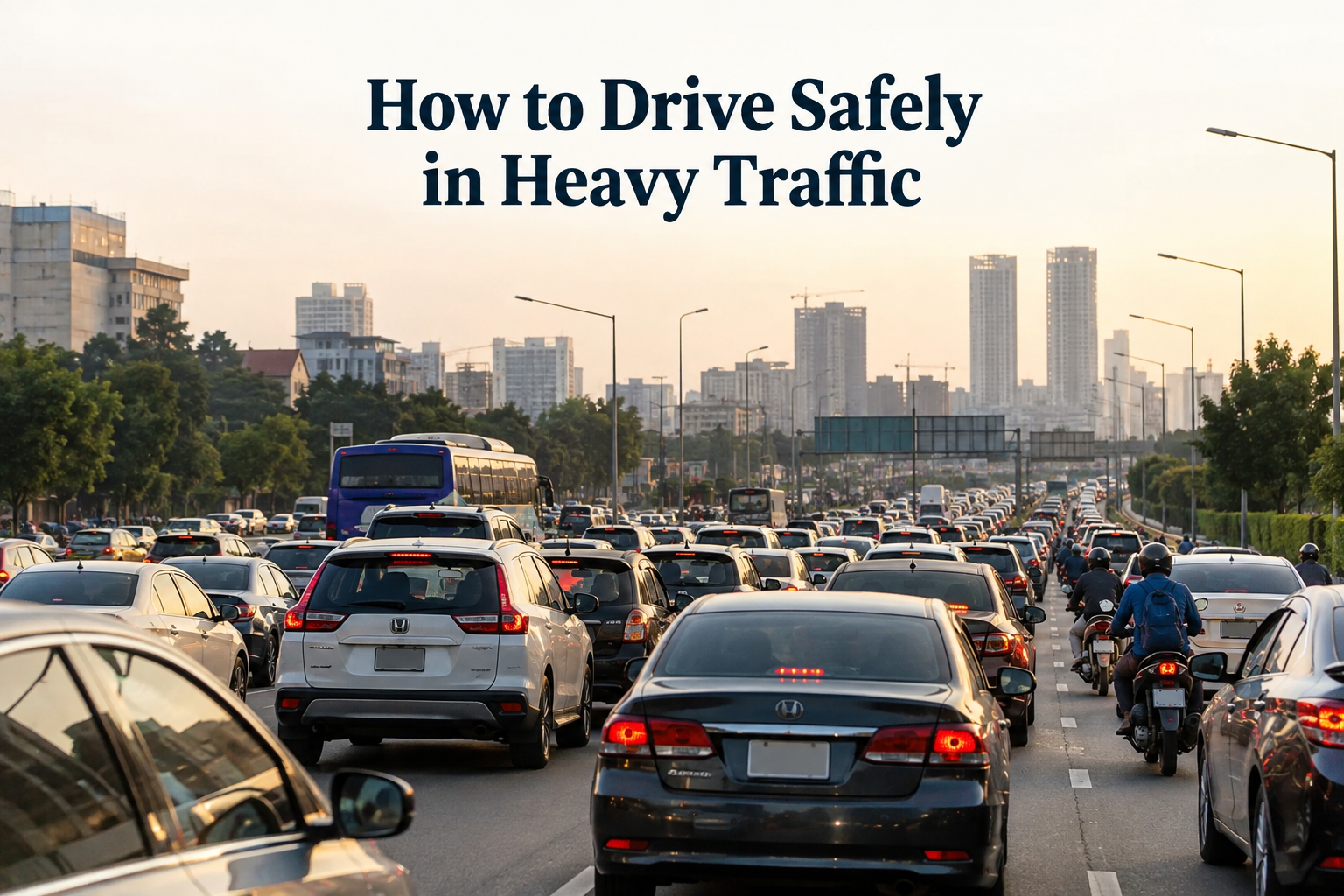
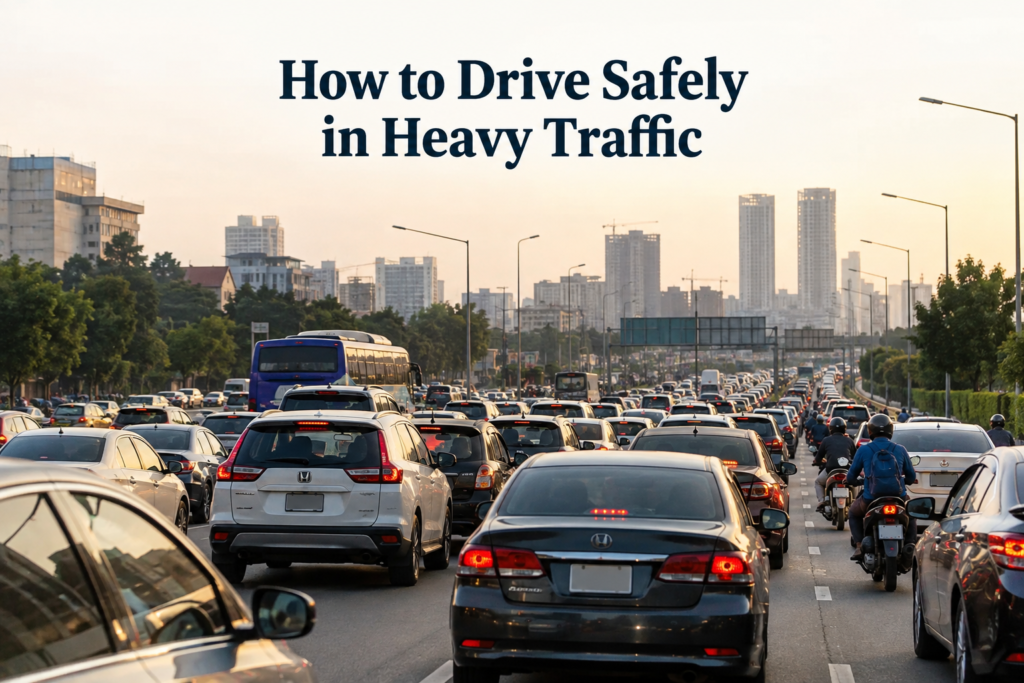
Driving in heavy traffic can be one of the most stressful situations for any driver. Roads become crowded, vehicles move slowly, motorcycles appear from unexpected directions, and drivers often become impatient. In such conditions, even a small mistake can cause an accident.
Learning how to drive safely in heavy traffic is important for both new and experienced drivers. Safe driving is not only about controlling the vehicle. It is also about staying patient, observing your surroundings, maintaining proper distance, and making calm decisions.
Heavy traffic is common in large cities, especially during office hours, school timings, public events, holidays, and bad weather. When traffic density increases, drivers have less space and less time to react. This makes defensive driving especially important.
In this guide, I will explain practical ways to drive safely in heavy traffic while reducing stress, avoiding unnecessary risks, and protecting yourself and other road users.
Stay Calm and Patient
The first rule of safe driving in heavy traffic is to remain calm.
Traffic jams can be frustrating. You may be late for work, an appointment, or an important meeting. However, becoming angry will not make traffic move faster.
Aggressive driving increases the risk of mistakes. A frustrated driver may accelerate suddenly, change lanes unnecessarily, follow another vehicle too closely, or react badly to another driver’s mistake.
Try to accept the situation and focus on safe driving.
Keep your hands relaxed on the steering wheel and avoid unnecessary arguments with other drivers.
If another driver cuts in front of you, give them space instead of trying to compete.
A few seconds of patience can prevent a serious accident.
Maintain a Safe Following Distance
Maintaining enough distance from the vehicle in front is extremely important.
In heavy traffic, many drivers stay very close to the vehicle ahead because they fear another driver may enter the gap. This is unsafe.
If the vehicle in front suddenly brakes, you need enough time and space to stop safely.
Even when traffic is moving slowly, keep a reasonable distance.
You should be able to see the rear tires of the vehicle in front touching the road surface when stopped. This gives you extra space if you need to move around the vehicle or if the traffic suddenly stops.
When traffic is moving faster, increase your following distance.
More space gives you more reaction time.
Avoid Sudden Braking
Sudden braking is common in congested traffic and can easily cause rear end collisions.
Always look several vehicles ahead instead of focusing only on the car directly in front of you.
If you notice traffic slowing in the distance, gently reduce your speed early.
Smooth braking gives drivers behind you more time to react.
Whenever possible, avoid pressing the brake pedal aggressively.
Gradual braking is safer, smoother, and more comfortable for everyone inside your vehicle.
Keep Your Speed Under Control
Driving too fast in heavy traffic is dangerous.
Traffic conditions can change within seconds. A vehicle may stop suddenly, a pedestrian may enter the road, or another driver may change lanes without warning.
Drive at a speed that allows you to react comfortably.
Do not accelerate quickly just because there is a small open space ahead.
You may only gain a few meters before having to brake again.
Smooth and controlled driving is usually safer and can also improve fuel efficiency.
Use Your Mirrors Regularly
Your mirrors are extremely important in crowded traffic.
Check your rearview mirror and side mirrors frequently.
You should always have an idea of what is happening around your vehicle.
Before changing lanes, check your mirrors carefully and look over your shoulder if necessary.
Motorcycles and bicycles can easily enter blind spots.
Never assume that the road beside you is clear simply because you cannot see another vehicle in the mirror.
Blind spot checking is essential.
Avoid Unnecessary Lane Changes
Constantly changing lanes usually does not save much time.
Drivers often move from one lane to another because the neighboring lane appears faster. A few moments later, the original lane may start moving again.
Frequent lane changes increase the risk of collisions because you repeatedly enter other drivers’ paths.
Choose a suitable lane and remain in it unless there is a genuine reason to change.
If you need to change lanes, signal early and wait for a safe gap.
Never force your vehicle into another lane.
Always Use Turn Signals
Turn signals communicate your intentions to other drivers.
Use them before changing lanes, turning, entering another road, or moving toward the side of the road.
In crowded conditions, other drivers need as much warning as possible.
Do not activate the signal at the exact moment you start turning.
Signal early enough to allow nearby drivers to understand what you plan to do.
Clear communication makes traffic movement more predictable and safer.
Watch for Motorcycles
Motorcycles can be difficult to notice in heavy traffic.
They may move between vehicles, appear beside your car, or enter blind spots.
Before opening your door, changing lanes, or moving sideways, check carefully for motorcycles.
Never make sudden movements without checking your surroundings.
Motorcycles are smaller than cars and offer much less protection to their riders. Even a minor collision can cause serious injury.
Giving them additional space is always a good idea.
Be Careful Around Pedestrians
Heavy traffic often means more pedestrians near the road.
People may cross between stopped vehicles, walk along the roadside, or suddenly appear in front of your car.
This commonly happens near markets, schools, bus stops, shopping areas, and busy intersections.
Drive slowly in areas with high pedestrian activity.
Never assume that a pedestrian has seen your vehicle.
Always be prepared to stop.
Keep Both Hands Ready to Control the Vehicle
During slow traffic, some drivers become relaxed and drive with only one hand while using their phone with the other.
This is dangerous.
Keep proper control of the steering wheel.
Even at low speed, unexpected situations can occur.
Another vehicle may suddenly enter your lane or the car ahead may stop instantly.
Keeping both hands ready allows you to react more quickly.
Do Not Use Your Phone While Driving
Mobile phone use is one of the biggest distractions on the road.
Reading messages, checking social media, watching videos, or typing while driving can take your attention away from traffic.
Some drivers believe phone use is safe when traffic is moving slowly.
It is not.
Heavy traffic actually requires more attention because vehicles are close together and conditions change constantly.
If you need to use your phone, stop in a safe location first.
Avoid Aggressive Driving
Aggressive driving creates unnecessary danger.
Common examples include tailgating, excessive horn use, blocking other vehicles, speeding into small gaps, and refusing to allow another driver to merge.
These actions increase stress and accident risk.
A responsible driver does not treat the road like a competition.
If another driver behaves aggressively, create distance and let them move away.
Your priority should be safety, not proving a point.
Watch Traffic Far Ahead
Good drivers do not only look at the vehicle directly in front of them.
Try to observe several vehicles ahead.
This helps you identify traffic changes earlier.
For example, if you see brake lights appearing several cars ahead, you can begin slowing down before the vehicle in front reacts.
Looking farther ahead allows smoother driving and gives you extra reaction time.
It also reduces sudden braking.
Leave Space at Intersections
Never enter an intersection unless you have enough space to clear it.
In heavy traffic, drivers sometimes move into an intersection even when the road ahead is blocked.
When the traffic signal changes, they remain stuck in the middle and block vehicles moving from another direction.
This makes congestion worse and increases the risk of collisions.
Wait behind the line until there is enough room for your vehicle on the other side.
Be Careful When Traffic Starts Moving
After sitting in a traffic jam, drivers often accelerate quickly as soon as traffic starts moving.
Avoid this habit.
The movement may only last for a few seconds before traffic stops again.
Accelerate gradually and keep enough distance from the vehicle ahead.
Smooth acceleration gives you better control and reduces fuel consumption.
Do Not Follow Large Vehicles Too Closely
Buses, trucks, and other large vehicles can block your view of the road ahead.
If you follow them too closely, you may not see traffic signals, pedestrians, road hazards, or braking vehicles in time.
Keep additional distance behind large vehicles.
This improves your visibility and gives you more reaction time.
Remember that large vehicles may also have larger blind spots.
Avoid staying beside them for long periods.
Understand Blind Spots
Every vehicle has areas that are difficult or impossible to see through the mirrors.
These are called blind spots.
Before moving sideways, check your mirrors and turn your head briefly to check the area beside your vehicle.
This is especially important in traffic where motorcycles and small cars can remain hidden.
Never rely only on mirrors when changing lanes.
Use the Horn Responsibly
The horn should be used to warn other road users of danger.
It should not be used simply because traffic is slow.
Continuous horn use does not make congestion disappear.
It only increases noise and stress.
Use the horn briefly when necessary, such as when another driver appears unaware of your vehicle.
Responsible horn use creates a calmer road environment.
Stay Alert at Traffic Signals
Traffic signals require extra attention during busy hours.
When approaching a signal, reduce your speed and prepare to stop.
Do not accelerate aggressively when the light changes.
Check the intersection before moving.
Sometimes vehicles or pedestrians may still be crossing even after your signal turns green.
A quick visual check can prevent an accident.
Keep Your Vehicle in Good Condition
Vehicle maintenance also affects safety in heavy traffic.
Your brakes, tires, lights, mirrors, and steering system should always work properly.
Heavy traffic involves frequent braking and acceleration.
Weak brakes or worn tires can make stopping more difficult.
Check tire pressure regularly and replace damaged tires.
Make sure your brake lights are working so drivers behind you can see when you slow down.
A properly maintained vehicle is easier and safer to control.
Keep Enough Fuel in the Tank
Traffic jams can last much longer than expected.
Running out of fuel in the middle of a busy road can create additional congestion and put you in an unsafe situation.
Try not to drive regularly with the fuel level extremely low.
Keeping enough fuel gives you peace of mind, especially during long journeys or rush hour traffic.
Plan Your Route Before Driving
One of the easiest ways to reduce traffic stress is to plan ahead.
Before leaving home, check your route.
If you know that a particular road becomes extremely congested during certain hours, consider using another route.
You can also leave earlier to avoid peak traffic periods.
Good planning reduces rushing and allows you to drive more calmly.
Keep Your Windows and Mirrors Clean
Visibility is essential in traffic.
Dirty windows and mirrors can make it difficult to see motorcycles, pedestrians, and nearby vehicles.
Keep your windshield, rear window, side windows, and mirrors clean.
During rain or dusty conditions, visibility may become even worse.
Make sure your windshield wipers work properly and keep enough washer fluid in the reservoir.
Avoid Driving When Extremely Tired
Fatigue reduces concentration and reaction speed.
Heavy traffic requires constant attention.
If you are very tired, you may react slowly when another vehicle brakes or changes lanes.
Get enough rest before driving whenever possible.
If you feel sleepy during a journey, stop somewhere safe and take a break.
Driving while exhausted can be extremely dangerous.
Stay Focused on the Road
Distractions do not only come from mobile phones.
Eating, adjusting music, searching for something inside the car, talking intensely with passengers, or looking at roadside activity can also reduce concentration.
Keep your attention on traffic.
If you need to adjust navigation, climate controls, or another setting, do it when the vehicle is safely stopped whenever possible.
Allow Other Vehicles to Merge
When another driver signals and needs to enter your lane, allowing reasonable space can help traffic move more smoothly.
You do not need to block every vehicle trying to merge.
In slow traffic, cooperative driving often reduces unnecessary braking and congestion.
This does not mean giving way in an unsafe situation.
Only allow another vehicle to merge when there is enough space.
Keep Your Emotions Under Control
Road rage can turn a small traffic problem into a dangerous situation.
Another driver may make a mistake, use the horn, or behave rudely.
Do not respond emotionally.
Avoid shouting, making gestures, chasing another vehicle, or trying to block it.
Stay focused on reaching your destination safely.
You cannot control how other people drive, but you can control your own decisions.
Drive Defensively
Defensive driving means preparing for possible mistakes made by other road users.
Never assume that everyone will follow the rules perfectly.
A vehicle may change lanes without signaling.
A pedestrian may cross unexpectedly.
A motorcycle may appear beside your car.
By expecting possible hazards, you can react sooner.
Defensive driving is especially valuable in congested traffic because vehicles are closely packed together.
Keep an Escape Space
Whenever possible, avoid becoming completely boxed in by surrounding vehicles.
Try to maintain some space around your car.
This gives you more options if something unexpected happens.
For example, if the vehicle ahead suddenly stops and you have space on one side, you may have more room to avoid a collision.
Creating space is one of the most effective defensive driving habits.
Be Extra Careful in Rain
Heavy traffic becomes more dangerous when roads are wet.
Braking distances increase and visibility decreases.
Reduce your speed and increase the distance between your car and the vehicle ahead.
Avoid sudden acceleration, hard braking, and sharp steering.
Turn on your headlights when visibility is poor.
Never drive quickly through standing water because you may lose control or damage your vehicle.
Use Air Conditioning Wisely
Long traffic jams can make the inside of a vehicle uncomfortable, especially in hot weather.
Use air conditioning to maintain a comfortable temperature so you can stay focused.
However, always make sure your vehicle’s cooling system is functioning correctly.
Older or poorly maintained vehicles may overheat while idling for long periods.
Watch the temperature gauge if you are stuck in traffic for a long time.
Keep Children Properly Seated
Children can become restless during traffic jams.
Make sure they remain properly seated and use suitable seat belts or child restraints.
Do not turn around repeatedly to deal with children while the vehicle is moving.
If something needs immediate attention, stop in a safe location.
Your attention should remain on the road.
Give Emergency Vehicles Space
If you hear or see an ambulance, fire vehicle, or other emergency vehicle, stay calm and create space when it is safe to do so.
Do not block intersections or make sudden dangerous movements.
Look around before moving your vehicle.
Emergency vehicles may be responding to situations where every second matters.
Avoid Blocking Side Roads and Driveways
When traffic stops, try not to block side streets, entrances, or driveways.
Leaving a reasonable opening allows vehicles to enter or exit without creating additional congestion.
It also reduces frustration among other road users.
Smooth Driving Saves Fuel
Heavy traffic can increase fuel consumption because vehicles repeatedly stop and accelerate.
You can reduce unnecessary fuel use by driving smoothly.
Avoid aggressive acceleration.
Allow the vehicle to roll gently when appropriate and maintain a steady speed whenever traffic allows.
Also avoid unnecessary idling when parked for extended periods, provided it is safe and appropriate for your vehicle.
Know When to Take a Break
Sometimes traffic conditions become mentally exhausting.
If you feel extremely stressed, angry, or tired, consider pulling over at a safe place.
A short break can help you regain concentration.
Driving requires clear judgment, and emotional stress can affect decision making.
Common Mistakes to Avoid in Heavy Traffic
Many drivers make similar mistakes in traffic jams.
These include following too closely, changing lanes repeatedly, using a phone, accelerating aggressively, blocking intersections, and driving emotionally.
Avoiding these habits can significantly improve safety.
Remember that reaching your destination a few minutes earlier is never worth risking an accident.
Final Thoughts
Learning how to drive safely in heavy traffic requires patience, awareness, and good judgment.
Congested roads may be frustrating, but aggressive driving rarely solves the problem. Staying calm, maintaining a safe following distance, checking mirrors, avoiding unnecessary lane changes, and watching for pedestrians and motorcycles can greatly reduce the risk of accidents.
Good drivers understand that road safety depends on cooperation.
You may not be able to control traffic conditions or the behavior of other drivers, but you can control your own actions.
Drive smoothly, remain alert, maintain your vehicle properly, and always give yourself enough time to react.
The safest driver is usually not the person who moves through traffic the fastest. It is the person who reaches the destination without putting themselves or anyone else at unnecessary risk.