Driving safely is not only about controlling the steering wheel or following traffic signals. One of the most important habits a driver can develop is maintaining a safe distance from the vehicle ahead. This simple practice gives you more time to react, helps prevent sudden collisions, and makes driving less stressful.
Many road accidents happen because drivers follow other vehicles too closely. A car in front may brake suddenly because of traffic, an animal crossing the road, a pedestrian, a pothole, or another unexpected situation. If your vehicle is too close, you may not have enough time or road space to stop safely.
Understanding how to maintain a safe distance while driving is therefore an essential part of responsible driving. It applies to city roads, highways, heavy traffic, wet conditions, and even slow moving traffic.
In this guide, I will explain what a safe following distance means, how to calculate it, what factors affect stopping distance, and how drivers can build safer habits on the road.
What Is a Safe Following Distance?
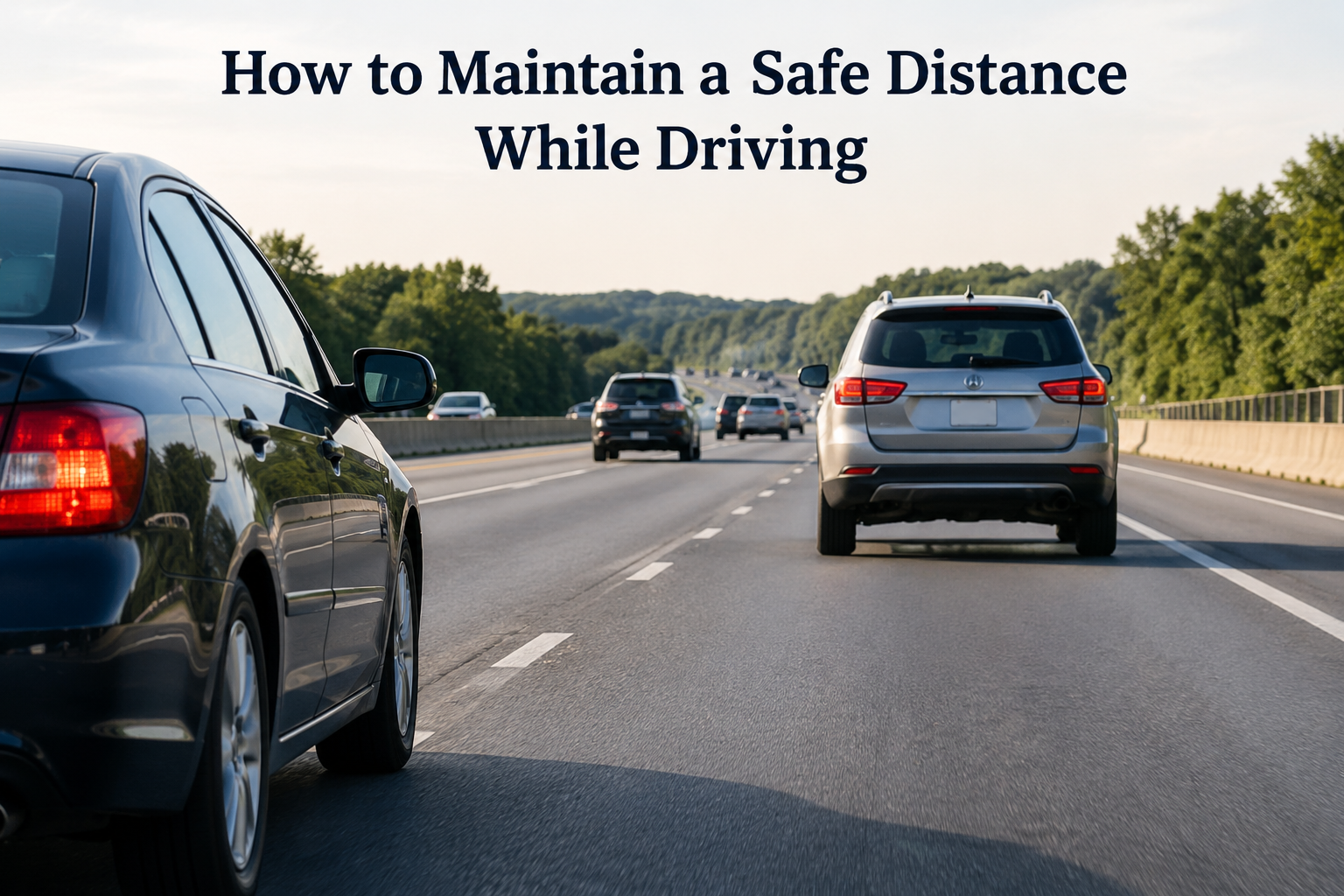
A safe following distance is the space you leave between your vehicle and the vehicle directly in front of you.
This space acts as a safety cushion.
If the driver ahead suddenly brakes, the distance gives you enough time to notice the situation, react, and stop your vehicle without crashing into them.
The correct distance is not always measured in meters because speed constantly changes. Instead, drivers usually find it easier to measure following distance in seconds.
The faster you travel, the more road space your vehicle covers every second. This means the physical distance between vehicles should naturally increase as speed increases.
A safe distance should therefore change according to your speed, road conditions, weather, visibility, traffic, and the condition of your vehicle.
Why Maintaining a Safe Distance Is So Important
Following another vehicle too closely is dangerous because it reduces your reaction time.
Imagine you are driving behind another car and its driver suddenly applies the brakes. Before your vehicle begins slowing down, several things have to happen.
First, your eyes notice the brake lights.
Then your brain recognizes that the vehicle ahead is stopping.
Next, you decide to brake.
Finally, your foot moves to the brake pedal and the braking system begins slowing the vehicle.
All of this takes time.
Even a careful driver cannot respond instantly. During that short period, the vehicle continues moving forward.
If enough distance is available, this delay is manageable. If there is almost no gap, a collision may become difficult to avoid.
Maintaining a safe driving distance gives you the space needed for this natural reaction process.
Understand the Three Second Rule
One of the easiest methods for maintaining a safe distance while driving is the three second rule.
Choose a fixed object on the roadside such as a sign, tree, bridge, pole, or building.
When the vehicle ahead passes that object, begin counting.
Count slowly:
One thousand one.
One thousand two.
One thousand three.
If your vehicle reaches the same point before you finish counting to three, you are following too closely.
Reduce your speed slightly and increase the distance.
The advantage of the three second rule is that it automatically adjusts according to speed.
At a low speed, three seconds represents a shorter physical distance.
At a higher speed, three seconds represents a much longer distance.
For normal driving conditions, this provides a useful minimum safety margin.
Increase the Distance in Difficult Conditions
Three seconds may be suitable under good driving conditions, but it should not be treated as a fixed rule for every situation.
Certain conditions require much more space.
During rain, fog, darkness, heavy traffic, or poor road conditions, consider increasing your following distance to four, five, or even six seconds.
More distance may also be necessary when driving behind trucks, buses, motorcycles, or vehicles carrying heavy loads.
The main principle is simple.
When driving conditions become more difficult, increase the space around your vehicle.
Extra distance gives you more time to understand what is happening and make a controlled decision.
Safe Distance in Rain
Rain changes road conditions significantly.
Water reduces the amount of grip between the tires and the road surface. Braking may therefore require more distance.
Visibility can also become poor because of heavy rain, spray from other vehicles, and fogged windows.
When driving in wet conditions, slow down and increase your following distance.
Do not assume that modern brakes or good tires will allow you to stop immediately.
Even vehicles equipped with advanced braking technology still depend on tire contact with the road.
Standing water can also create the risk of hydroplaning, where the tires temporarily lose proper contact with the road surface.
Keeping a larger distance reduces the need for sudden braking and allows smoother control.
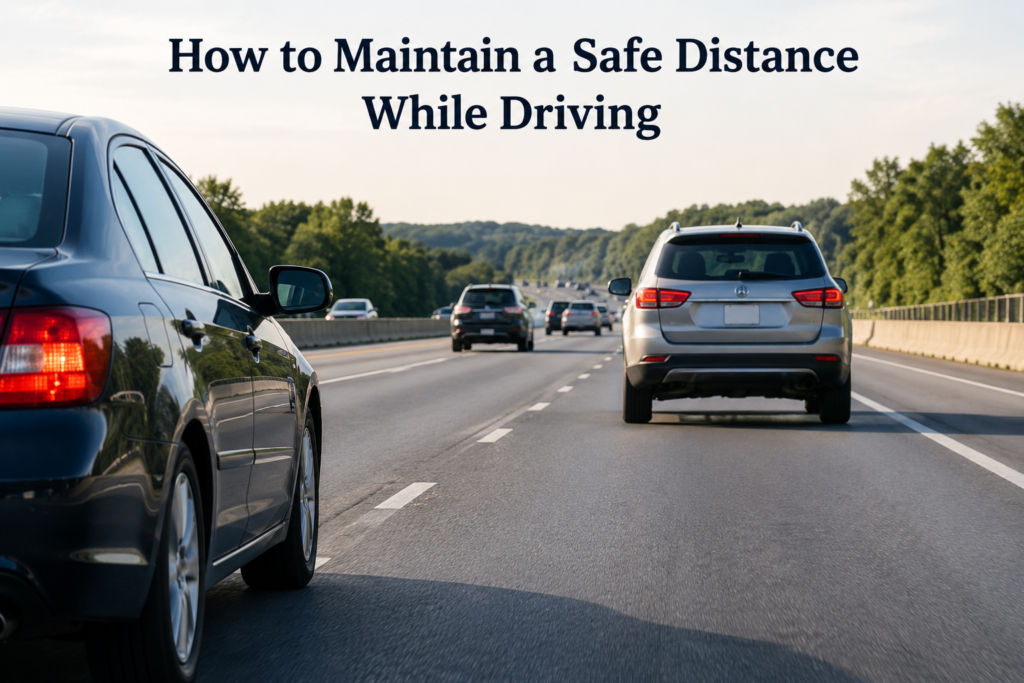
Safe Distance on Highways
Highway driving requires greater attention to following distance because vehicles are moving at higher speeds.
A small gap that appears acceptable at low speed can become extremely dangerous at highway speed.
At higher speeds, your vehicle covers a large distance every second.
You also need more road space to stop.
When driving on a highway, avoid following another vehicle simply because everyone else seems to be driving closely together.
Create your own safety space.
If another driver enters the gap in front of you, do not become frustrated. Gradually reduce your speed and rebuild a safe distance.
Safe driving is not about defending your position in traffic. It is about creating enough space to respond safely.
Understand Reaction Distance and Braking Distance
Stopping distance has two major parts.
The first is reaction distance.
The second is braking distance.
Reaction distance is the distance your vehicle travels between noticing a danger and beginning to brake.
Braking distance is the distance the vehicle travels after the brakes are applied until the vehicle stops completely.
Together, these create the total stopping distance.
Many drivers focus only on the power of their brakes, but reaction distance is equally important.
A distracted driver may take much longer to recognize danger.
Looking at a mobile phone, adjusting controls, eating, talking to passengers, or becoming lost in thought can increase reaction time.
This is another reason maintaining a safe distance is essential.
Speed Greatly Affects Stopping Distance
As speed increases, stopping becomes more difficult.
Drivers sometimes assume that doubling speed simply doubles stopping distance. In reality, braking distance can increase much more dramatically.
Higher speed means the vehicle has more energy that must be reduced before it can stop.
This is why maintaining a safe distance at higher speeds is extremely important.
A driver travelling slowly in city traffic may have enough space to stop within a relatively short distance.
The same vehicle travelling much faster on a highway requires considerably more room.
Always increase your following distance as your speed increases.
Avoid Tailgating
Tailgating means driving extremely close behind another vehicle.
Some drivers do this because they are impatient.
Others may not realize how little space they are leaving.
Tailgating is one of the most dangerous driving habits because it removes the safety cushion between vehicles.
It also creates pressure on the driver ahead.
The front driver may feel nervous and react unpredictably.
Tailgating rarely helps you reach your destination significantly faster. It mainly increases the risk of an accident.
If you notice that you are getting too close to another vehicle, reduce the accelerator slightly and allow the gap to increase.
There is usually no need to brake suddenly.
A smooth reduction in speed is often enough.
What to Do If Someone Is Following You Too Closely
Sometimes the problem is not your own following distance.
Another driver may be tailgating you.
Avoid reacting emotionally.
Do not repeatedly press your brakes to scare the other driver.
Do not accelerate beyond a safe speed simply because someone is pressuring you.
Maintain control of your vehicle.
If possible, allow the other driver to pass safely.
On a multi lane road, move to another lane when it is safe and legal.
Your goal should be to remove yourself from the risky situation, not to teach the other driver a lesson.
Keep Extra Distance Behind Large Vehicles
Driving behind trucks and buses requires special care.
Large vehicles can block your view of the road ahead.
If you follow too closely, you may not see traffic signals, stopped vehicles, road hazards, or changing traffic conditions until it is too late.
Large vehicles also require more space to stop.
Keeping extra distance gives you a wider field of vision.
A useful habit is to position your vehicle far enough back that you can see more of the road around the larger vehicle.
This improves your ability to anticipate problems.
Keep a Safe Distance Behind Motorcycles
Motorcycles require careful attention because they may slow down differently from cars.
A motorcycle can also be affected by road surfaces that may not seriously affect a larger vehicle.
Loose gravel, potholes, water, oil, or damaged pavement may cause a motorcyclist to change direction quickly.
Give motorcycles plenty of room.
Never follow closely simply because a motorcycle is smaller than a car.
The rider needs the same safety space, and often more, because of the greater vulnerability of two wheel vehicles.
Increase Distance at Night
Night driving reduces visibility.
Even with good headlights, you cannot see as far ahead as you can during daylight.
Your ability to notice pedestrians, animals, road damage, or stopped vehicles may also be reduced.
Because you receive less visual information, maintaining a larger following distance is helpful.
Keep your windshield clean, make sure your lights are working correctly, and avoid driving so fast that you cannot stop within the visible area ahead.
Safe distance and safe speed should always work together.
Maintain Distance in Fog
Fog can reduce visibility very quickly.
When visibility becomes poor, reduce speed gradually and increase your following distance.
Do not follow another vehicle closely simply because you are using its lights as a guide.
The driver ahead may stop suddenly.
If visibility becomes severely limited, continue only when conditions allow safe driving and follow local road safety guidance.
The poorer the visibility, the more time and space you need.
Maintain Distance in Heavy Traffic
Heavy traffic can tempt drivers to close every gap.
People often worry that another vehicle will enter the space in front of them.
This creates a chain of vehicles driving too closely together.
Instead, maintain a reasonable gap.
This allows smoother driving because you do not need to brake every time the vehicle ahead slows slightly.
You can reduce the accelerator and let your vehicle slow naturally.
This improves comfort and may also reduce unnecessary fuel consumption.
A safe gap can make stop and go traffic much easier to manage.
Watch More Than One Vehicle Ahead
Safe drivers do not look only at the vehicle directly in front of them.
Whenever possible, look farther down the road.
Observe several vehicles ahead.
If you see brake lights appearing in the distance, you can begin slowing before the vehicle directly in front of you reacts.
This gives you more control and reduces the need for sudden braking.
Looking farther ahead is one of the best defensive driving habits.
It turns driving from a reactive activity into a more predictable one.
Be Careful on Hills and Curves
Hills and curves can reduce visibility.
You may not be able to see stopped traffic, an accident, road construction, or another hazard until you are relatively close.
Reduce your speed before entering areas where the road ahead is hidden.
Keep enough distance from the vehicle ahead so that you have space to respond if traffic suddenly slows.
Never depend entirely on the movements of the car in front.
Always try to create your own view of the road.
Vehicle Condition Matters
Safe following distance is also affected by the condition of your vehicle.
Worn tires may have less grip.
Poor brakes may increase stopping distance.
Incorrect tire pressure can influence handling and braking performance.
Worn windshield wipers can reduce visibility during rain.
Weak headlights can make night driving more difficult.
Regular vehicle maintenance supports safe driving because the vehicle responds more predictably when an emergency occurs.
Check your tires, brakes, lights, windshield, and other important systems regularly.
Avoid Distractions
Even a large following distance can become unsafe if the driver is distracted.
Using a phone while driving can take your attention away from the road at the exact moment traffic changes.
A few seconds of distraction can cover a considerable amount of road.
Keep your eyes on traffic and your hands ready to control the vehicle.
Set navigation before beginning your journey whenever possible.
Adjust mirrors, climate controls, and other settings while parked.
The safer your attention level, the more useful your following distance becomes.
Adjust Your Distance When Carrying Heavy Loads
A heavily loaded vehicle may require more distance to stop.
The additional weight changes how the vehicle responds during braking and cornering.
If your car is carrying several passengers, luggage, or heavy cargo, allow more space between your vehicle and traffic ahead.
Drivers of commercial vehicles and heavily loaded vans should be especially aware of increased stopping requirements.
Whenever vehicle weight increases, a more cautious driving style is appropriate.
Avoid Sudden Lane Changes
Maintaining safe distance also means avoiding situations where you enter another driver’s safety space.
Before changing lanes, check your mirrors and blind spots.
Make sure there is enough room both in front of and behind your vehicle.
Do not move into a small gap and immediately force another driver to brake.
When you change lanes smoothly and leave sufficient space, traffic becomes safer for everyone.
Use Smooth Braking
A good following distance allows smooth braking.
If you constantly need to brake suddenly, you may be driving too close or failing to look far enough ahead.
Try to notice traffic changes early.
When you see traffic slowing in the distance, ease off the accelerator.
Apply the brakes gradually when required.
Smooth braking improves passenger comfort, helps maintain vehicle stability, and gives drivers behind you more time to respond.
Leave Extra Space Near Intersections
Intersections are unpredictable areas.
Vehicles may turn suddenly.
Pedestrians may cross.
Traffic lights may change.
Motorcycles and bicycles may appear beside traffic.
When approaching an intersection, avoid driving closely behind another vehicle.
Leave enough space so that if the driver ahead stops suddenly, you can stop without difficulty.
The same principle applies when approaching pedestrian crossings and school zones.
Safe Distance When Stopped in Traffic
Following distance also matters when vehicles are stationary.
When stopping behind another car, avoid moving so close that you cannot easily maneuver.
A practical approach is to stop where you can still see the lower part of the rear tires of the vehicle ahead meeting the road.
The exact visible area can vary depending on your seating position and vehicle design, but the basic idea is to leave some usable space.
This gap can be helpful if the vehicle ahead rolls backward or if you need to move around it during an emergency.
Do Not Copy Aggressive Drivers
Sometimes drivers feel pressured to follow the behavior of surrounding traffic.
If everyone is driving too close together, it may begin to feel normal.
But common behavior is not always safe behavior.
Develop your own safety standard.
Keep enough distance for the conditions, even when another driver chooses not to.
Good driving is based on observation, judgment, and preparation rather than imitation.
Use Distance to Reduce Driving Stress
Maintaining a safe distance is not only about preventing accidents.
It can also make driving calmer.
When you follow too closely, every brake light becomes an urgent event.
You constantly switch between the accelerator and brake pedal.
Your attention becomes focused on the bumper directly ahead.
With more space, you can see traffic developing earlier.
You can slow gradually and maintain a more consistent speed.
The entire driving experience becomes smoother and less tiring.
Build the Habit Every Day
Safe following distance should become automatic.
Whenever you drive, periodically check the gap between your vehicle and the one ahead.
Ask yourself whether you would have enough time to stop if the driver suddenly applied the brakes.
If the answer is uncertain, increase the distance.
Over time, this becomes a natural habit.
You will begin creating safety space without consciously thinking about it.
This is one of the signs of mature driving.
Common Mistakes Drivers Should Avoid
Several mistakes can reduce safe following distance.
Driving too close because traffic is moving slowly is one example.
Another is assuming that good brakes guarantee quick stopping.
Drivers also make mistakes when they allow impatience to control their decisions.
Speeding toward slower traffic and braking at the last moment creates unnecessary risk.
Another mistake is looking only at the vehicle directly ahead instead of observing the wider traffic environment.
The safest approach combines proper distance, attention, reasonable speed, and early observation.
Final Thoughts
Learning how to maintain a safe distance while driving is one of the simplest ways to reduce accident risk.
The space between your vehicle and the vehicle ahead gives you something extremely valuable: time.
It gives you time to notice danger.
It gives you time to understand what is happening.
It gives you time to brake.
It gives you time to make a safer decision.
Use the three second rule as a practical starting point in normal conditions and increase the gap whenever weather, visibility, speed, road conditions, or traffic make driving more difficult.
Avoid tailgating, watch traffic farther ahead, keep your vehicle properly maintained, and stay focused on the road.
Safe driving is rarely about making one dramatic decision. It is usually the result of many small, sensible habits practiced consistently.
Maintaining a safe following distance is one of those habits. It may seem simple, but the extra space you leave today could prevent a serious accident tomorrow.