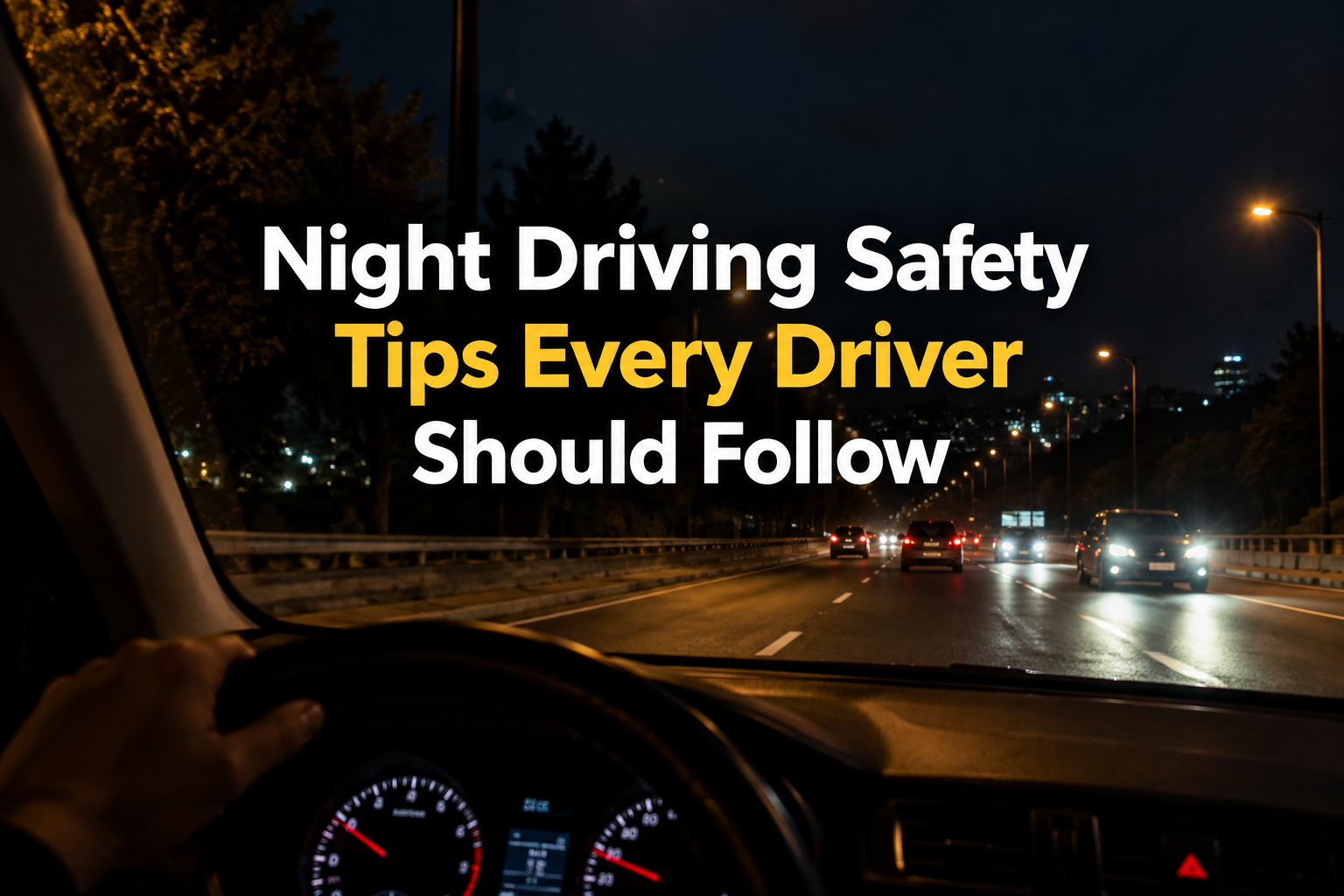
Driving at night can feel peaceful because roads are often quieter and traffic is lighter. However, nighttime driving also creates several challenges that are not always present during the day. Reduced visibility, tiredness, bright headlights, unexpected pedestrians, and animals crossing the road can make nighttime journeys more demanding.
Many drivers become comfortable behind the wheel after years of experience, but night driving requires extra attention regardless of how experienced someone may be. Your eyes receive less information in darkness, which means you may have less time to recognize hazards and react safely.
Following proper night driving safety tips can help you stay alert, improve visibility, and reduce unnecessary risks. Small habits such as cleaning your windshield, checking your lights, slowing down, and avoiding distractions can make a major difference.
This guide explains practical night driving safety tips every driver should follow when traveling after sunset.
Why Night Driving Requires Extra Care
Human vision works best in good lighting. At night, the eyes have to adjust to darkness while constantly dealing with headlights, streetlights, signs, and reflections.
Objects that are easy to recognize during daylight may become difficult to notice at night. Pedestrians wearing dark clothing, bicycles, parked vehicles, damaged roads, and animals may appear suddenly.
Distance can also be harder to judge in poor lighting. A vehicle ahead may appear farther away than it actually is, especially on roads without streetlights.
Night driving also often happens at a time when the body naturally starts preparing for sleep. Even if you do not feel extremely tired, concentration and reaction speed may decrease after a long day.
Understanding these challenges is the first step toward safer nighttime driving.
Make Sure Your Headlights Are Working Properly
Your headlights are one of your most important safety tools when driving at night.
Before starting a nighttime journey, check that both headlights are working properly. A damaged bulb can seriously reduce your ability to see the road and may also make your vehicle harder for other drivers to notice.
Headlights should also be properly aligned. Lights pointing too low may not illuminate enough of the road ahead, while lights pointing too high can disturb approaching drivers.
Older headlight lenses sometimes become cloudy or yellow because of sunlight and environmental exposure. Cloudy lenses can reduce the amount of light reaching the road.
Cleaning or restoring the lenses can improve nighttime visibility significantly.
You should also check your brake lights, indicators, parking lights, and rear lights regularly. Other road users depend on these lights to understand what your vehicle is doing.
Clean Your Windshield Before Driving
A windshield that looks reasonably clean during the day can become surprisingly difficult to see through at night.
Dust, fingerprints, water marks, and oily residue can scatter light from approaching vehicles. This creates glare and may make your entire windshield appear hazy.
Clean both the inside and outside surfaces of the windshield regularly.
Do not forget the side windows and mirrors. Clear glass allows you to recognize vehicles, pedestrians, and road conditions more easily.
Your windshield wipers should also be in good condition. Worn blades may leave streaks that become especially distracting when light reflects from wet roads.
A clean windshield is one of the simplest night driving safety tips, but it can make a noticeable difference.
Reduce Your Speed at Night
One common mistake drivers make is maintaining the same speed at night that they would use in bright daylight.
Your safe speed should depend on how far you can clearly see ahead.
Imagine driving quickly on a dark road where your headlights illuminate only a limited distance. If an obstacle suddenly appears beyond that visible area, you may not have enough time to stop safely.
Driving slightly slower gives you more time to recognize hazards.
This becomes even more important on unfamiliar roads, narrow streets, rural routes, mountain roads, and areas with limited lighting.
You do not necessarily need to drive unusually slowly. Instead, choose a speed that allows you to remain comfortable and maintain control within the distance you can clearly see.
Increase the Distance Between Vehicles
Maintaining a safe following distance is always important, but it becomes even more valuable at night.
When visibility is limited, you may notice changes in traffic slightly later than usual.
Leaving additional space between your vehicle and the vehicle ahead gives you more time to react if the other driver suddenly brakes.
Avoid following closely simply because traffic seems lighter.
A larger safety gap can also reduce the effect of sudden brake lights on your eyes and give you a wider view of the road ahead.
If weather conditions are poor, increase the distance even further.
Rain, fog, and wet roads can increase stopping distance and reduce visibility at the same time.
Avoid Staring at Oncoming Headlights
Bright headlights can temporarily affect your ability to see clearly.
When a vehicle approaches with powerful lights, avoid looking directly at them.
Instead, keep your attention on your lane and use road markings or the edge of the road as a visual reference.
Your eyes will recover more quickly if you avoid direct exposure to the brightest part of the approaching light.
After the vehicle passes, give your eyes a moment to readjust to the darkness.
Keeping your windshield clean also helps reduce glare because dirt and scratches can scatter bright light across your field of vision.
Use High Beams Carefully
High beams can greatly improve visibility on dark roads, particularly in rural areas.
However, they must be used responsibly.
High beams should not be used when approaching another vehicle because the intense light can reduce the other driver’s vision.
They should also be lowered when following another vehicle closely because strong light reflecting through the mirrors can distract the driver ahead.
Use high beams when the road is dark and clear, then switch back to normal headlights when other road users are nearby.
Responsible use of vehicle lighting improves safety for everyone.
Keep Your Interior Lights Low
Bright interior lighting can reduce your ability to see the road outside.
Modern vehicles often have adjustable dashboard brightness settings. At night, reduce the brightness to a comfortable level.
The display should remain easy to read without becoming distracting.
Avoid turning on strong cabin lights while driving unless absolutely necessary.
Bright screens can create similar problems.
If your navigation system, phone, or entertainment display has a night mode, use it. Lower screen brightness can reduce eye strain and help your eyes remain adjusted to darker road conditions.
Stay Alert for Pedestrians and Cyclists
Pedestrians and cyclists can be especially difficult to notice at night.
Someone wearing dark clothing may blend into the surroundings until your headlights reach them.
Reduce your speed near residential areas, pedestrian crossings, bus stops, schools, shops, and intersections.
Watch carefully for movement at the sides of the road.
Cyclists may sometimes have weak lights or small reflectors, so do not rely only on bright visual signals.
Always scan the road ahead rather than focusing only on the vehicle directly in front of you.
Watch for Animals on Dark Roads
Animal crossings are another nighttime hazard, particularly outside cities.
Animals can enter the road unexpectedly and may behave unpredictably when frightened by headlights.
When driving through rural areas, forests, farmland, or locations where animals are common, reduce your speed and scan both sides of the road.
Sometimes the reflection of headlights in an animal’s eyes may be visible before the animal itself becomes clear.
If you see one animal crossing the road, remain cautious because others may be nearby.
Avoid sudden steering movements whenever possible because losing control of the vehicle can create an even more serious situation.
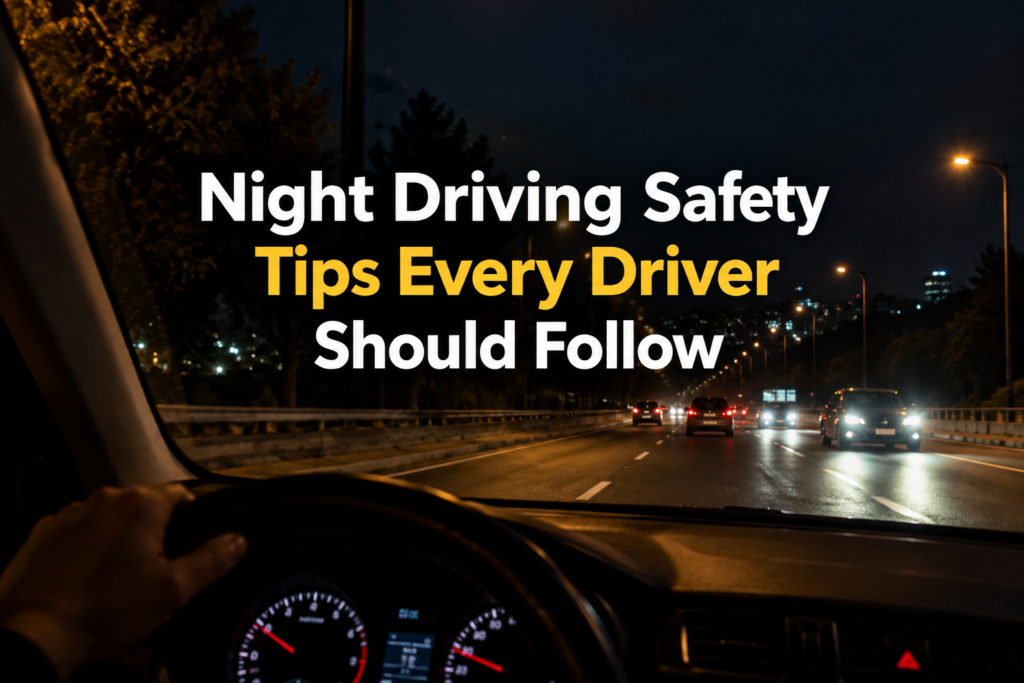
Never Drive When You Are Extremely Tired
Fatigue is one of the greatest dangers associated with nighttime driving.
A tired driver may have slower reactions, reduced concentration, and difficulty keeping the vehicle centered in the lane.
Warning signs of tiredness include frequent yawning, heavy eyelids, difficulty remembering the last few kilometers, missing road signs, drifting within the lane, and struggling to maintain concentration.
Do not assume that opening a window or increasing music volume will solve serious fatigue.
If you are becoming sleepy, find a safe place to stop and rest.
A short break may improve alertness, but if you are extremely tired, proper sleep is the safest solution.
Reaching your destination slightly later is better than taking unnecessary risks.
Avoid Using Your Phone While Driving
Phone distraction is dangerous at any time, but the risk can become even greater at night.
Looking at a bright phone screen briefly can reduce your ability to see darker surroundings immediately afterward.
More importantly, taking your eyes off the road even for a short time means you may miss a pedestrian, stopped vehicle, turn, or road hazard.
Set navigation before starting your journey.
If you need to make changes, stop somewhere safe before using your phone.
Messages and social media notifications can wait until the vehicle is safely parked.
Keeping your attention on the road is one of the most important night driving safety tips every driver should remember.
Check Your Mirrors Regularly
Night driving requires good awareness of what is happening around your vehicle.
Check your mirrors regularly without staring at them for long periods.
Some vehicles have an automatic dimming rearview mirror that reduces glare from headlights behind you. Traditional mirrors often have a manual night setting.
Using these features can reduce discomfort from bright headlights.
Make sure mirrors are properly adjusted before beginning your journey.
Correct mirror positioning can improve visibility and reduce unnecessary blind spots.
Be Extra Careful During Rain
Driving at night in rain combines two visibility problems at the same time.
Rain reduces visibility, while wet roads reflect headlights and streetlights. These reflections can make lane markings and road edges harder to recognize.
Reduce your speed and increase your following distance.
Use your windshield wipers and headlights appropriately.
Avoid sudden acceleration, heavy braking, and sharp steering.
If rain becomes so heavy that you cannot clearly see the road, consider stopping safely until conditions improve.
Good visibility should always be more important than maintaining your planned travel time.
Be Careful When Driving in Fog
Fog can make nighttime driving extremely difficult.
Normal headlights may reflect from water droplets in the fog, creating glare.
Use low beam headlights when driving through fog. If your vehicle has fog lights, use them appropriately.
Reduce your speed significantly and maintain extra distance from other vehicles.
Do not follow the rear lights of another vehicle too closely simply because they are easier to see.
You still need enough distance to stop if traffic suddenly slows.
Keep Your Eyes Moving
Staring at one point of the road for a long time can reduce awareness.
Instead, continuously scan the road.
Look ahead, check your mirrors, observe intersections, and watch the edges of the road.
This technique helps you notice potential hazards earlier.
Try to look far enough ahead to understand what traffic is doing while still paying attention to nearby conditions.
Good drivers are constantly collecting information from different parts of their surroundings.
Take Extra Care on Unfamiliar Roads
Driving somewhere unfamiliar at night can be challenging because you may not know where turns, intersections, speed changes, or road hazards are located.
Reduce your speed and give yourself extra time.
Set your navigation system before starting the journey and listen to voice guidance instead of repeatedly looking at the screen.
Pay attention to road signs and lane markings.
If you miss a turn, continue driving until you can safely change direction.
Never make a sudden maneuver simply because your navigation system tells you that you passed an exit.
Keep Your Vehicle Properly Maintained
Vehicle maintenance has a direct connection with nighttime driving safety.
Good brakes, properly inflated tires, working lights, clean windows, functional wipers, and reliable steering systems all help you respond safely to unexpected situations.
Check tire condition regularly because worn tires may have less grip, particularly on wet roads.
Brake problems should never be ignored.
If your vehicle pulls to one side, vibrates heavily, makes unusual sounds, or shows warning lights, consider having the issue inspected before taking a long nighttime journey.
A well maintained vehicle gives the driver greater confidence and control.
Avoid Alcohol and Other Impairing Substances
Driving requires clear judgment and quick reactions.
Alcohol can affect coordination, concentration, decision making, and reaction speed.
The safest approach is simple. If you have consumed alcohol or another substance that can impair driving, do not drive.
Certain medicines can also cause sleepiness or slower reactions.
Read medication instructions carefully and follow medical advice regarding driving.
If you feel unusually sleepy or unfocused after taking medication, arrange another method of transportation.
Plan Long Night Journeys Carefully
Preparation becomes especially important when traveling long distances after dark.
Before leaving, check your fuel level, tires, lights, route, and weather conditions.
Keep your phone charged for emergencies, but do not use it while driving.
Plan rest stops along the route.
If possible, avoid beginning a long journey when you are already exhausted after a full day of work.
A rested driver usually makes better decisions and remains focused for longer periods.
Keep Emergency Supplies in Your Car
Unexpected problems can happen even when a vehicle is properly maintained.
Keeping a few basic emergency items in your vehicle can be helpful.
Useful items may include a flashlight, reflective warning equipment, drinking water, basic first aid supplies, a phone charging cable, and necessary vehicle tools.
If your vehicle breaks down at night, move it away from traffic if it is safe to do so.
Turn on your hazard lights and make the vehicle visible to other road users.
Your personal safety should come before attempting complicated repairs beside a busy road.
Adjust Your Driving to the Conditions
There is no single driving speed or technique that is perfect for every nighttime journey.
A brightly illuminated city road may require different behavior from a dark rural road.
Similarly, clear weather, heavy rain, fog, traffic, road construction, and unfamiliar surroundings all require different levels of caution.
Good drivers continuously adjust their behavior.
If visibility decreases, reduce speed.
If traffic becomes unpredictable, increase your following distance.
If you become tired, stop.
Safe driving is not about following one fixed routine. It is about recognizing changing conditions and responding appropriately.
Do Not Let Other Drivers Pressure You
Sometimes another driver may follow closely or appear impatient because you are driving cautiously.
Do not allow this pressure to make you drive faster than feels safe.
Maintain control of your vehicle and follow road rules.
When appropriate and safe, allow faster traffic to pass.
Your goal is to arrive safely, not to compete with another driver.
Night driving already provides less information than daytime driving, so unnecessary speed only reduces your available reaction time.
Keep Your Mind Focused on Driving
Long nighttime roads can become monotonous.
Your mind may start wandering even if you are not physically tired.
Keep your attention on the driving environment.
Observe traffic movement, road signs, lane markings, and potential hazards.
Avoid becoming deeply involved in conversations or entertainment that reduces concentration.
Driving may feel routine, but road conditions can change within seconds.
Maintaining mental focus allows you to respond more effectively when something unexpected happens.
Final Thoughts
Night driving can be safe and comfortable when drivers understand its challenges and adjust their behavior accordingly.
The most effective night driving safety tips are often simple. Keep your headlights and windows clean, reduce your speed when visibility is limited, maintain a safe following distance, avoid staring at bright headlights, and remain alert for pedestrians, cyclists, and animals.
Fatigue deserves special attention. If you feel sleepy, do not rely on temporary tricks to remain awake. Stop somewhere safe and rest.
Your vehicle also plays an important role in safety. Properly maintained tires, brakes, lights, mirrors, and windshield wipers help you maintain control and visibility after dark.
Most importantly, avoid distractions and give yourself enough time to react.
Nighttime driving does not need to feel stressful. With good preparation, patience, and careful observation, you can reduce risks and make your journey safer for yourself, your passengers, and everyone else using the road.