A car air conditioning system is something most drivers do not think about until the temperature outside becomes uncomfortable. You start the engine, turn the AC on, and expect cold air to come through the vents within a few moments. When that does not happen, even a short drive can quickly become unpleasant.
If your car AC is not cooling properly, the problem does not always mean that the entire air conditioning system has failed. Sometimes the cause is simple, such as a dirty cabin air filter. In other situations, the problem may involve refrigerant, the compressor, cooling fans, electrical components, or another part of the AC system.
Understanding how a car AC works can make it much easier to identify possible problems. It can also help you explain the symptoms clearly when you take the vehicle to a mechanic.
In this guide, I will explain the most common reasons why your car AC is not cooling properly, the symptoms you may notice, and what can be done to restore comfortable cooling.
How a Car Air Conditioning System Works
Before looking at possible problems, it helps to understand the basic operation of the car air conditioning system.
The system does not actually create cold air in the way many people imagine. Instead, it removes heat from the air inside the vehicle.
Refrigerant circulates through the AC system. The compressor pressurizes the refrigerant and sends it toward the condenser. The condenser helps remove heat from the refrigerant before it travels through other parts of the system.
The refrigerant eventually reaches the evaporator inside the dashboard. As air passes across the cold evaporator surface, heat is removed from the air. The blower fan then pushes the cooled air through the vents into the passenger compartment.
Several components must work together correctly for this process to happen efficiently.
If one part becomes damaged, blocked, dirty, or weak, the AC may stop producing cold air.
Low Refrigerant Level
One of the most common reasons a car AC is not cooling properly is a low refrigerant level.
Refrigerant is essential because it absorbs and transfers heat through the air conditioning system. When the amount of refrigerant becomes too low, the AC cannot cool the air effectively.
You may notice that the air coming from the vents feels slightly cool but never becomes truly cold.
Another common symptom is that the AC works better while driving but becomes warmer when the car is stopped.
Refrigerant normally travels through a sealed system. This means that if the refrigerant level is very low, there may be a leak somewhere.
Simply adding refrigerant without finding the leak may only provide temporary improvement.
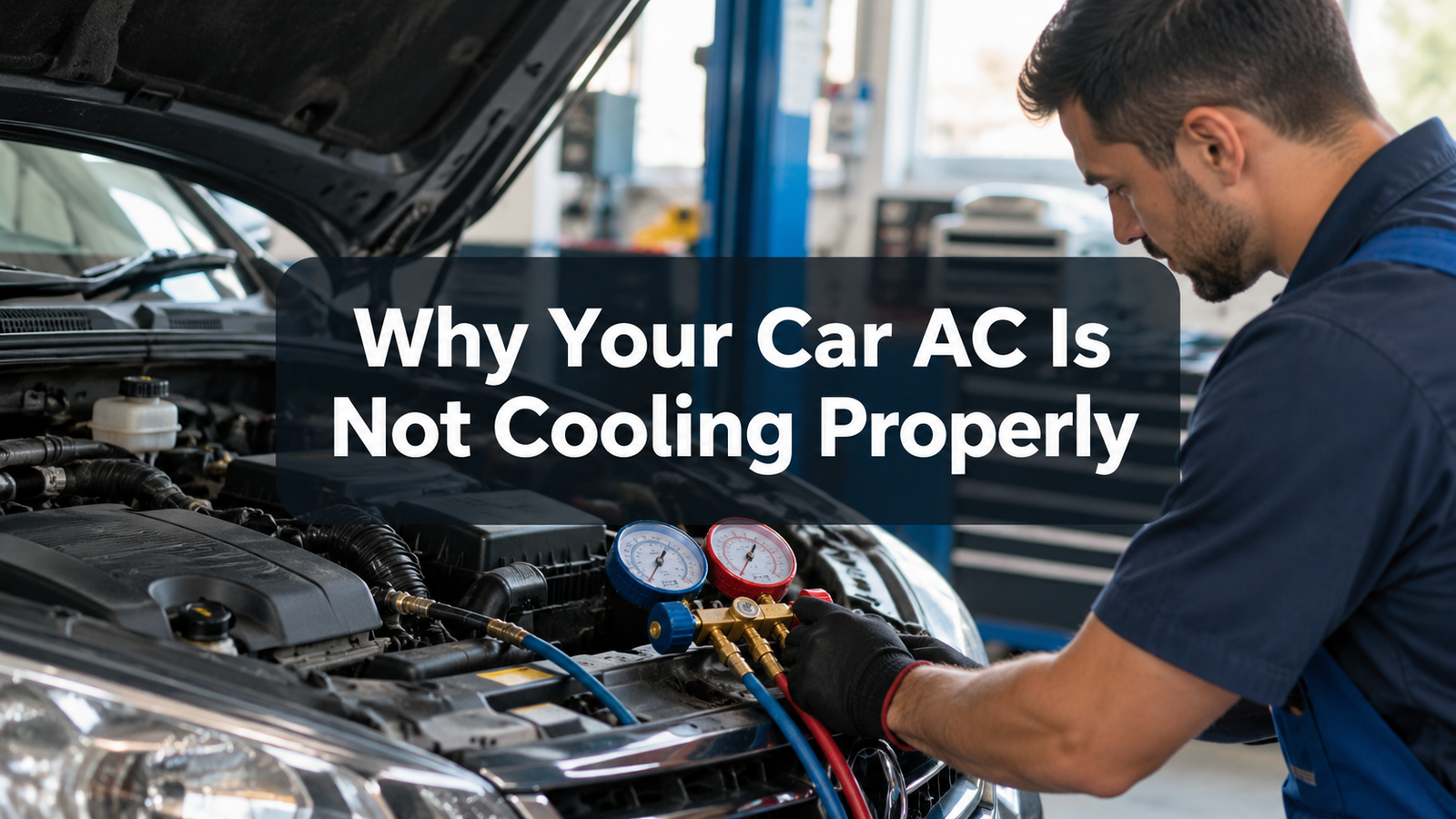
A technician can inspect the system, check the operating pressure, and look for refrigerant leaks before refilling it.
Refrigerant Leak
A refrigerant leak can slowly reduce the cooling ability of the AC system.
Leaks may occur around seals, hoses, connections, the condenser, evaporator, compressor, or other AC components.
Some refrigerant leaks are very small and may take months before the driver notices a major difference in cooling performance.
Other leaks can cause the AC to stop cooling within a short period.
Possible signs of a refrigerant leak include weak cooling, oily marks near AC components, repeated loss of refrigerant, and AC performance that gets worse over time.
Finding a leak can sometimes require special equipment because refrigerant may escape without leaving an obvious visible mark.
A proper inspection is important before adding more refrigerant.
Dirty Cabin Air Filter
Many modern vehicles have a cabin air filter that cleans the air entering the passenger compartment.
Over time, this filter can become filled with dust, leaves, dirt, pollen, and other debris.
A badly clogged cabin filter restricts airflow.
The AC system may still produce cold air, but the airflow coming from the vents becomes weak.
This can make it feel as though the AC is not cooling properly because not enough cold air is reaching the cabin.
Replacing the cabin air filter is usually a simple maintenance job.
The replacement interval depends on the vehicle and driving environment. Cars frequently driven in dusty areas may require more frequent filter replacement.
Checking the filter is often one of the easiest places to start when AC airflow feels weaker than normal.
Faulty AC Compressor
The compressor is one of the most important parts of the air conditioning system.
Its job is to circulate refrigerant through the system and create the pressure needed for proper cooling.
If the compressor becomes weak or damaged, the AC may struggle to produce cold air.
A failing compressor can produce several symptoms.
You may hear unusual noises when the AC is switched on. Cooling may become inconsistent. In some cases, the AC may stop working completely.
Some compressors use a clutch that engages when cooling is required.
If the compressor clutch does not engage, refrigerant may not circulate properly.
Compressor problems should normally be diagnosed by a qualified technician because replacing parts without proper testing can become expensive.
Condenser Problems
The AC condenser is normally located near the front of the vehicle, often close to the radiator.
Its position allows outside air to flow across it while driving.
The condenser releases heat from the refrigerant before it continues through the system.
Because the condenser sits near the front of the car, it can become dirty or damaged by road debris, insects, leaves, mud, and dust.
If airflow through the condenser becomes restricted, heat cannot escape efficiently.
The result may be poor AC cooling, especially during very hot weather.
A damaged condenser may also allow refrigerant to leak.
During a routine inspection, check whether the condenser appears blocked or physically damaged.
Gentle cleaning may improve airflow if dirt is the main problem, but damaged components may require professional repair.
Cooling Fan Not Working Properly
Your car may have one or more electric fans near the radiator and condenser.
These fans help move air across the condenser, especially when the vehicle is stopped or moving slowly.
A faulty cooling fan can create an interesting symptom.
The AC may feel cold while driving at normal road speed but become warmer when sitting in traffic or parked with the engine running.
This happens because natural airflow while driving helps cool the condenser. When the vehicle stops, the electric fan becomes more important.
If the fan does not operate correctly, condenser temperature can rise and AC performance may decrease.
Problems may involve the fan motor, relay, fuse, wiring, temperature control, or another electrical component.
Blocked or Dirty Evaporator
The evaporator is located inside the vehicle, usually behind the dashboard.
It plays an important role because air flowing across the evaporator is cooled before entering the cabin.
Over time, dust and moisture can collect around the evaporator.
This may reduce airflow and cooling efficiency.
Moisture around the evaporator can also contribute to unpleasant smells from the vents.
A badly contaminated evaporator may require professional cleaning because access can be difficult on many vehicles.
Keeping the cabin air filter clean can help reduce the amount of dirt reaching the evaporator.
Blower Motor Problems
The blower motor pushes air through the vents.
If the blower motor becomes weak, the AC system may still cool the air correctly, but the airflow inside the cabin may not be strong enough.
You may notice that some fan speeds do not work or that airflow suddenly becomes weaker.
Sometimes the issue is not the blower motor itself.
The problem can involve the blower resistor, electrical connector, switch, fuse, or wiring.
If your AC produces cold air but the airflow feels unusually weak, the blower system should be inspected.
AC Pressure Sensor Problems
Modern vehicles use sensors to monitor pressure inside the air conditioning system.
These sensors help protect the compressor and control AC operation.
If a pressure sensor sends incorrect information, the system may prevent the compressor from operating even when refrigerant pressure is actually normal.
This can cause the AC to stop cooling.
Because sensor problems can resemble other AC faults, proper testing is important before replacing a sensor.
Diagnostic equipment can often help identify electrical faults stored in the vehicle computer.
Electrical Problems
Modern car air conditioning systems rely heavily on electrical components.
A damaged fuse, relay, wire, connector, switch, control module, or sensor can prevent the AC from working correctly.
Electrical problems may cause the system to work only sometimes.
For example, the AC may work when the car first starts and suddenly stop later.
Some electrical faults are easy to identify, while others require wiring diagrams and diagnostic tools.
If the AC problem appears suddenly without any earlier reduction in cooling performance, checking fuses and electrical components may be useful.
Faulty Temperature Blend Door
Inside the dashboard, small doors control how air moves through the heating and cooling system.
One of these components is commonly known as the blend door.
It controls how much air passes through the heater core and how much passes through the cooling section.
If the blend door becomes stuck or the actuator controlling it fails, warm air may mix with cold air.
You may then notice that the AC system is running but the air coming from the vents remains warm.
Sometimes one side of the cabin may blow cold air while the other side blows warm air.
This symptom is especially common in vehicles with separate temperature controls for the driver and passenger.
Too Much Refrigerant
Low refrigerant can reduce cooling performance, but adding too much refrigerant can also create problems.
The AC system is designed to operate with a specific amount of refrigerant.
Overcharging the system can cause pressure to become too high and may reduce cooling efficiency.
It can also place additional stress on the compressor and other components.
For this reason, refrigerant should not be added simply because the AC feels warm.
The correct system pressure and refrigerant quantity should be checked first.
Engine Overheating
In some vehicles, AC performance may decrease when the engine temperature becomes too high.
The vehicle computer may reduce or disable AC operation to protect the engine.
If you notice that your AC stops cooling at the same time the engine temperature rises, the cooling system should be inspected immediately.
Possible causes may include low coolant, radiator problems, a faulty cooling fan, thermostat problems, or another engine cooling issue.
Do not ignore engine overheating because it can lead to serious engine damage.
AC Works Better at Night Than During the Day
Some drivers notice that their AC feels cold during the evening but struggles during extremely hot afternoons.
A small difference is normal because the AC has to remove much more heat when the outside temperature is very high.
However, a properly functioning system should still provide comfortable cooling.
If the difference is extreme, the system may have slightly low refrigerant, weak condenser airflow, a dirty condenser, or another problem that becomes more noticeable under heavy heat.
Parking under shade and using a windshield sunshade can reduce cabin temperature before driving, but these measures should not be used as substitutes for AC repair.
AC Is Cold While Driving but Warm at Idle
This is one of the most useful symptoms for diagnosing an AC problem.
If the system cools properly while driving but becomes warm when stopped, condenser airflow should be checked.
At road speed, air naturally passes through the condenser.
At idle, the cooling fan must provide much of this airflow.
A weak or failed fan is therefore a common cause of this symptom.
Low refrigerant or condenser problems can also produce similar behavior.
AC Blows Cold Air and Then Becomes Warm
If the AC starts cold but becomes warm after several minutes, several possibilities should be considered.
The compressor may be switching off unexpectedly.
The evaporator may be freezing.
A sensor may be malfunctioning.
Refrigerant pressure may also be outside the correct operating range.
If the system starts working again after being switched off for a while, evaporator freezing may be worth investigating.
Proper pressure testing and temperature measurements can help identify the exact cause.
Can You Fix Car AC Problems at Home?
Some basic checks can be done at home.
You can inspect the cabin air filter, check whether airflow is strong, look at the condenser for obvious dirt, and see whether cooling fans operate when the AC is running.
You can also check the vehicle manual for information about AC related fuses.
However, refrigerant systems require care.
Refrigerant operates under pressure, and incorrect servicing can damage the system or create safety risks.
Modern vehicles may also use different refrigerant types that require specific equipment.
If the problem involves refrigerant pressure, leaks, compressors, or internal AC components, professional diagnosis is usually the safer approach.
How to Keep Your Car AC Working Properly
Regular maintenance can help the air conditioning system remain reliable.
Run the AC occasionally even during cooler months. This helps circulate lubricant through important system components.
Keep the cabin air filter clean and replace it when necessary.
Remove leaves and heavy dirt from the area around the condenser.
Pay attention to changes in cooling performance.
A gradual reduction in cooling can be easier and less expensive to repair when investigated early.
If refrigerant must be added repeatedly, ask for a leak inspection rather than continuing to refill the system.
When Should You Visit a Mechanic?
You should consider professional inspection if the AC produces no cold air at all, makes unusual noises, loses cooling repeatedly, shows signs of refrigerant leakage, or works inconsistently.
Professional AC equipment can measure both high and low side system pressure.
Technicians can also check vent temperature, compressor operation, electrical signals, refrigerant quantity, and possible leaks.
These tests help identify the real cause instead of replacing parts based only on guesswork.
Final Thoughts
There are many reasons why your car AC is not cooling properly. The problem may be as simple as a dirty cabin air filter or as serious as a damaged compressor.
Low refrigerant, refrigerant leaks, condenser problems, faulty cooling fans, electrical faults, weak blower motors, temperature control problems, and blocked evaporators can all reduce cooling performance.
The symptoms you notice can provide useful clues.
Weak airflow may point toward a filter or blower problem. Cold air while driving but warm air at idle may indicate a cooling fan issue. Gradually decreasing cooling may suggest low refrigerant or a leak.
The most important approach is to diagnose the cause before replacing parts or adding refrigerant.
A properly maintained air conditioning system not only keeps the cabin comfortable during hot weather but also improves the overall driving experience.
Regular inspections, clean filters, proper refrigerant levels, and quick attention to unusual symptoms can help your car AC continue working efficiently for many years.