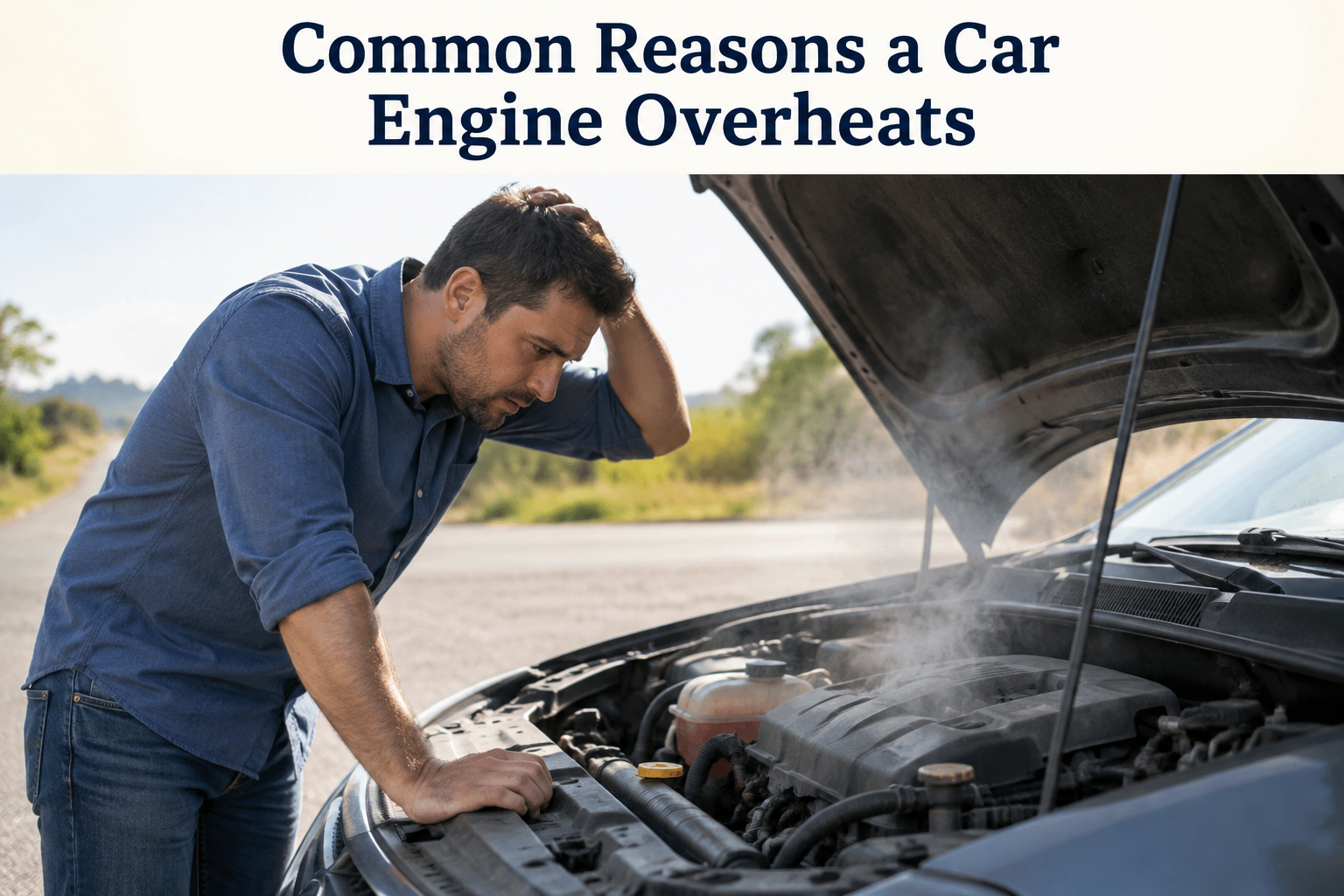
A car engine is designed to operate within a specific temperature range. During normal driving, thousands of small explosions take place inside the engine, creating enough heat to damage metal components if that heat is not controlled properly. This is why every modern vehicle uses a cooling system to keep the engine at a safe operating temperature.
When something goes wrong with that cooling system, the engine temperature can rise quickly. An overheating engine is not a minor issue. If ignored, it may damage the cylinder head, head gasket, pistons, valves, radiator, or even the complete engine.
Understanding the common reasons a car engine overheats can help drivers notice problems early and avoid expensive repairs. In many cases, overheating starts with a simple issue such as low coolant, a damaged hose, or a faulty thermostat.
This guide explains the most common causes of engine overheating, the warning signs to watch for, what to do if your car overheats, and how to reduce the chances of the problem happening again.
What Does Engine Overheating Mean?
Engine overheating happens when the engine produces more heat than the cooling system can remove.
Under normal conditions, coolant circulates through passages inside the engine. It absorbs heat and carries it toward the radiator. Air passing through the radiator then removes much of that heat before the coolant returns to the engine.
If coolant stops circulating properly, airflow becomes restricted, or the cooling system loses pressure, engine temperature can rise beyond the normal range.
Most vehicles have a temperature gauge on the dashboard. The needle normally stays somewhere around the middle once the engine has warmed up.
If the gauge starts moving toward the hot section, the cooling system may have a problem.
Some vehicles also display a warning message or temperature warning light.
1. Low Coolant Level
One of the most common reasons a car engine overheats is low coolant.
Coolant is responsible for carrying heat away from the engine. If the coolant level becomes too low, there may not be enough liquid circulating through the engine and radiator.
As a result, engine temperature can rise quickly.
Coolant levels may drop because of a leak, poor maintenance, or gradual loss over time.
Drivers should regularly check the coolant reservoir when the engine is completely cold.
If the coolant level keeps falling after being topped up, there is probably a leak somewhere in the system.
Never assume that repeatedly adding coolant is a permanent solution. The reason for the coolant loss should always be investigated.
2. Coolant Leak
A coolant leak can happen almost anywhere in the cooling system.
Common leak locations include the radiator, water pump, coolant reservoir, heater core, thermostat housing, radiator hoses, and hose connections.
Some coolant leaks are easy to notice because they leave a colored liquid under the vehicle.
Depending on the coolant being used, the fluid may appear green, pink, orange, blue, or yellow.
Other leaks are much smaller and may only occur when the engine becomes hot and the cooling system is under pressure.
A sweet smell around the engine bay can also indicate leaking coolant.
White or colored deposits around hoses and radiator connections may be another sign.
Even a small coolant leak should not be ignored because the cooling system depends on maintaining the correct coolant level and pressure.
3. Faulty Thermostat
The thermostat is a small but important part of the cooling system.
When the engine is cold, the thermostat remains closed so the engine can reach its normal operating temperature more quickly.
Once the engine becomes warm, the thermostat opens and allows coolant to flow toward the radiator.
If the thermostat becomes stuck closed, coolant cannot circulate properly through the radiator.
This can cause the engine temperature to rise very quickly.
A failing thermostat may produce symptoms such as sudden overheating, unstable temperature readings, poor cabin heating, or unusually slow engine warm up.
Because thermostats are relatively inexpensive compared with engine repairs, they are often replaced when they show signs of failure.
4. Radiator Problems
The radiator plays a major role in controlling engine temperature.
Hot coolant enters the radiator, where heat is transferred through small tubes and cooling fins. Air moving through the radiator carries the heat away.
If the radiator becomes clogged internally, coolant flow may become restricted.
External dirt can also create problems.
Dust, mud, leaves, insects, and road debris can block airflow through the radiator fins.
Older radiators may develop corrosion inside the cooling passages, especially when the wrong coolant or plain water has been used for long periods.
A leaking or heavily clogged radiator may not be able to remove enough heat from the coolant.
This can lead to overheating, particularly during hot weather or long drives.
5. Cooling Fan Failure
The radiator cooling fan helps move air through the radiator when the vehicle is moving slowly or standing still.
At highway speeds, natural airflow normally passes through the radiator.
However, when the car is sitting in traffic, the cooling fan becomes much more important.
If the fan stops working, the car may stay cool while driving at higher speeds but begin overheating when stopped at traffic lights or moving slowly.
A cooling fan can fail because of a damaged fan motor, blown fuse, faulty relay, temperature sensor problem, damaged wiring, or control module issue.
If the engine gets hot mainly while idling but cools down while driving, the radiator fan should be checked.
6. Water Pump Failure
The water pump circulates coolant throughout the engine cooling system.
Without proper circulation, hot coolant cannot move efficiently from the engine toward the radiator.
Water pumps may fail because of worn bearings, damaged seals, broken internal impellers, or belt problems.
Some water pumps begin leaking before they completely fail.
Others may continue spinning while the internal impeller becomes damaged and loses the ability to move enough coolant.
Possible signs of a failing water pump include coolant leakage, engine overheating, unusual grinding noises, or coolant stains near the pump.
Because water pumps are essential for coolant circulation, a serious pump failure can cause overheating very quickly.
7. Broken or Loose Drive Belt
In some engines, the water pump is driven by an accessory belt or serpentine belt.
If that belt becomes loose, damaged, or broken, the water pump may stop circulating coolant properly.
A broken belt may also affect the alternator, power steering, or air conditioning system depending on the vehicle design.
Drivers may notice a battery warning light, heavy steering, unusual noises, or immediate temperature increase.
The drive belt should be inspected during routine maintenance.
Cracks, glazing, missing sections, or excessive looseness can indicate that replacement is needed.
8. Blocked Radiator Hose
Coolant travels between the engine and radiator through rubber hoses.
Over time, these hoses may weaken, collapse internally, crack, or become blocked.
A hose can look normal from the outside while being damaged inside.
A collapsed lower radiator hose can restrict coolant flow, especially when the engine is running at higher speeds.
Hoses may also become soft, swollen, or brittle with age.
During regular maintenance, radiator hoses should be checked for cracks, leaks, unusual softness, and damaged connections.
Replacing an old hose is far cheaper than repairing engine damage caused by overheating.
9. Air Trapped in the Cooling System
Air inside the cooling system can interfere with coolant circulation.
This problem sometimes occurs after coolant replacement, radiator repair, thermostat replacement, or cooling system maintenance.
If the system is not filled and bled correctly, air pockets may remain trapped inside the engine or heater core.
These air pockets can prevent coolant from reaching certain areas.
The result may be unstable temperature readings, poor heater performance, bubbling sounds, or overheating.
Many vehicles have specific procedures for removing trapped air.
Some require bleeding screws, special filling tools, or a particular engine warm up procedure.
Following the correct process is important after cooling system repairs.
10. Blown Head Gasket
A damaged head gasket is one of the more serious causes of engine overheating.
The head gasket seals the connection between the engine block and cylinder head.
It keeps engine oil, coolant, and combustion pressure separated.
If the gasket fails, combustion gases may enter the cooling system.
Coolant may also enter the combustion chambers or mix with engine oil.
Possible signs of a damaged head gasket include persistent overheating, white exhaust smoke, coolant loss without an obvious external leak, bubbling inside the coolant reservoir, milky engine oil, or excessive pressure in the cooling system.
A head gasket problem should be diagnosed professionally because continuing to drive may cause major engine damage.
11. Low Engine Oil
Engine oil is mainly used for lubrication, but it also helps reduce heat inside the engine.
When the oil level becomes too low, moving engine components create more friction.
More friction means more heat.
Low oil alone may not always cause immediate overheating, but it can contribute to higher engine temperatures and serious internal damage.
Drivers should check engine oil regularly using the dipstick or electronic oil level system.
If oil levels drop repeatedly, the vehicle may have an oil leak or be burning oil internally.
Both conditions should be inspected.
12. Incorrect Coolant Mixture
Coolant is normally mixed with water in a specific ratio recommended by the vehicle manufacturer.
Using only plain water may appear to work temporarily, but it does not provide the same protection as proper engine coolant.
Coolant contains additives that help prevent corrosion, freezing, boiling, and deposits inside the cooling system.
Using the wrong type of coolant can also create problems.
Some coolant formulas are not designed to be mixed together.
When incompatible coolant types are combined, deposits or sludge may develop and restrict circulation.
The safest approach is to follow the coolant specification listed in the vehicle owner’s manual.
13. Faulty Radiator Cap
The radiator cap may look simple, but it helps control cooling system pressure.
Cooling systems are designed to operate under pressure because pressurized coolant can withstand higher temperatures before boiling.
If the radiator cap cannot maintain the correct pressure, coolant may boil earlier than expected.
The system may also lose coolant through the overflow reservoir.
A faulty cap can cause overheating even when the radiator, water pump, and thermostat are working correctly.
Because the radiator cap is relatively inexpensive, it is often checked when diagnosing unexplained cooling system problems.
14. Clogged Cooling Passages
Coolant travels through narrow passages inside the engine block, cylinder head, radiator, and heater core.
Over time, rust, mineral deposits, contaminated coolant, and old sealants can block these passages.
Restricted passages reduce coolant circulation and heat transfer.
This problem is more common in vehicles that have used plain tap water for long periods or have not had the cooling system maintained properly.
A cooling system flush may help remove some contamination.
However, heavily blocked systems may require professional cleaning or component replacement.
15. Heavy Driving Conditions
Sometimes the cooling system is working correctly but the engine is placed under unusually heavy load.
Examples include towing a heavy trailer, driving uphill for long periods, carrying excessive weight, driving in extreme heat, or operating the vehicle at very low speeds for long periods.
These conditions increase the amount of heat generated by the engine.
A healthy cooling system should usually manage normal demanding conditions, but a weak radiator, aging fan, partially clogged system, or low coolant level may only become noticeable under heavy load.
This is why some overheating problems appear only during summer, long climbs, or towing.
Signs Your Car Engine Is Overheating
The temperature gauge moving toward the hot zone is the most obvious warning.
However, other signs may appear before serious overheating occurs.
You may notice steam coming from under the hood, a strong coolant smell, reduced engine power, strange ticking sounds, warning lights, poor air conditioning performance, or coolant leaking under the car.
The cabin heater may also suddenly start blowing cold air because coolant is no longer circulating correctly through the heater core.
Any unusual temperature behavior should be taken seriously.
What Should You Do If Your Car Overheats?
If the temperature gauge moves into the hot zone, reduce engine load immediately.
Turn off the air conditioning.
If it is safe to do so, move the vehicle away from traffic and stop.
Switch off the engine and allow it to cool completely.
Never open the radiator cap while the engine is hot.
The cooling system may be under high pressure, and boiling coolant can cause serious burns.
After the engine has cooled, check the coolant reservoir and look for obvious leaks.
If coolant is pouring out, the fan is not working, or the engine overheats again soon after restarting, the safest option is usually to stop driving and arrange proper inspection or towing.
Driving an overheating engine can turn a small cooling system repair into a major engine replacement.
Can You Drive With an Overheating Engine?
It is generally not a good idea.
Engine overheating can warp aluminum cylinder heads, damage the head gasket, score cylinder walls, damage pistons, and affect engine bearings.
Even a short period of severe overheating can cause permanent damage.
If the temperature returns to normal after stopping, this does not necessarily mean the problem has disappeared.
The underlying cause should still be identified.
How to Prevent Engine Overheating
Preventing overheating is usually easier and cheaper than repairing the damage caused by it.
Check the coolant level regularly when the engine is cold.
Inspect the ground under the vehicle for coolant leaks.
Keep the radiator clean.
Have worn hoses and belts replaced before they fail.
Use the coolant type recommended by the manufacturer.
Change coolant according to the vehicle maintenance schedule.
Pay attention to changes in the temperature gauge.
Cooling system parts such as thermostats, radiator caps, fans, and water pumps should also be inspected when symptoms appear.
Small warning signs can provide valuable time before a serious overheating event occurs.
Why Regular Cooling System Maintenance Matters
Cooling systems often receive less attention than engine oil, tires, or brakes.
However, the cooling system protects some of the most expensive parts of the vehicle.
Old coolant gradually loses its protective properties.
Rubber hoses become weaker.
Radiator fins collect dirt.
Thermostats wear out.
Water pump seals and bearings age.
Regular inspection allows these problems to be found before they cause overheating.
A well maintained cooling system also helps the engine operate more efficiently and maintain a stable temperature in different weather conditions.
Frequently Asked Questions
Why does my car overheat when idling but cool down while driving?
This often points toward an airflow problem.
The radiator cooling fan may not be working correctly.
At higher speeds, natural airflow passes through the radiator and keeps the engine cooler. When the vehicle stops, the fan must provide that airflow.
Why does my car overheat when the air conditioning is on?
Using the air conditioning places extra load on the engine and increases heat around the radiator and condenser.
If the cooling system is already weak, turning on the air conditioning may reveal the problem.
Possible causes include a weak cooling fan, dirty radiator, low coolant, or restricted airflow.
Can low coolant cause overheating?
Yes.
Low coolant is one of the most common causes of engine overheating.
Without enough coolant, the cooling system cannot transfer engine heat effectively.
Can low oil make a car overheat?
Low engine oil can contribute to overheating because lubrication is reduced and friction increases.
Severely low oil can also cause serious internal engine damage.
How long should I wait before opening the radiator cap?
There is no universal waiting time because cooling depends on engine design and weather conditions.
The radiator cap should only be opened when the engine is completely cool and there is no pressure remaining in the cooling system.
Can a bad thermostat cause overheating?
Yes.
A thermostat that becomes stuck closed can block coolant circulation toward the radiator and cause the engine to overheat rapidly.
Can a bad radiator cap really cause overheating?
Yes.
The radiator cap maintains cooling system pressure.
If the cap cannot hold the correct pressure, coolant may boil at a lower temperature or escape from the system.
Final Thoughts
There are many common reasons a car engine overheats, but most involve the same basic issue. The cooling system is unable to remove heat from the engine quickly enough.
Low coolant, coolant leaks, thermostat failure, radiator problems, cooling fan failure, water pump damage, blocked hoses, trapped air, low engine oil, and head gasket failure are among the most frequent causes.
The most important thing is to respond quickly when the temperature gauge rises.
Continuing to drive an overheating vehicle can cause severe and expensive engine damage.
Regular maintenance, correct coolant, routine inspections, and attention to warning signs can greatly reduce the risk of overheating.
A stable engine temperature is not only important for reliability. It also protects the engine, improves performance, and helps the vehicle remain dependable for many years.